Kraków – 65.18 points, Gdańsk – 60.94 points, Szczecin – 47.29 points and Wrocław – 43.29 points. The four Polish cities participating in the 2026 GDS-Index have completed another year of the international sustainability benchmarking programme for destinations. Kraków, Gdańsk and Szczecin improved their scores, with Szczecin recording the largest increase – 13.12 points.
The results of the 2026 GDS-Index were announced on 23 September. This year’s edition shows a clear improvement across the programme: 89% of destinations assessed in both 2025 and 2026 increased their scores, while the average reached a record 74.27 points. Since the recurring assessment began in 2016, the average participant score has risen by 45.5%.
Since 2016, 167 destinations from 38 countries have participated in the GDS-Index, completing a total of 705 assessments.
Polish cities in the 2026 GDS-Index
Three Polish destinations improved their overall scores. Szczecin recorded the largest increase, followed by Gdańsk and Kraków. Wrocław finished the 2026 edition with a score 0.52 points lower than the previous year, while also being recognised for progress in the Environmental category.
Szczecin – the largest increase in Poland
Szczecin increased its score from 34.17 to 47.29 points, an improvement of 13.12 points in just one year. The city has been participating in the GDS-Index for only two years.
An even greater change was recorded in the Destination Management category. Szczecin improved its score in this area by 38.5 points, placing the city third in the Most Improved Destination ranking.
This result is particularly significant in the context of this year’s global trends. Across the GDS-Index, Destination Management was the fastest-improving area, increasing by an average of 6.2 percentage points. The Supplier category rose by 5.1 points, Social by 3.5 points and Environmental by 2.6 points.
In practice, this reflects a shift in focus from simply developing strategies towards destination management, measuring results, working with the local industry and implementing concrete solutions.
Szczecin had an additional opportunity to work on these areas in 2026. From 16 to 18 June, the city hosted the GDS-Forum & Impact Day 2026 – an international event organised by GDS-Movement and #MEET4IMPACT in cooperation with the City of Szczecin and Szczecin Convention Bureau, with the Polish Tourism Organisation – Poland Convention Bureau as a partner.
Gdańsk – 7.5 points higher and clear progress among suppliers
Gdańsk achieved 60.94 points, compared with 53.44 points a year earlier, representing an increase of 7.50 points.
The greatest improvement came in the Supplier category, which covers hotels, conference venues, restaurants, event agencies and other local tourism and MICE service providers.
Gdańsk’s score in this category increased from 21.79 to 39.74 points – a rise of 17.95 points. In the Social category, the city improved from 57.89 to 67.57 points, while its Destination Management score increased from 59.46 to 68.49 points.
The result is also important from the perspective of the GDS-Index as a whole. Data from 2026 demonstrates a strong relationship between a destination’s performance and the level of sustainability certification within its local industry. Among destinations in the Top 40, certification is held by an average of:
- 81% of assessed congress and convention centres, compared with 58% outside the Top 40;
- 66% of eligible hotel rooms, compared with 48% outside the Top 40;
- 50% of event agencies, compared with 22% outside the Top 40.
For a convention bureau, this means that results cannot be built through city authority initiatives alone. The entire local supply chain needs to be engaged.
Kraków – the highest score among Polish cities
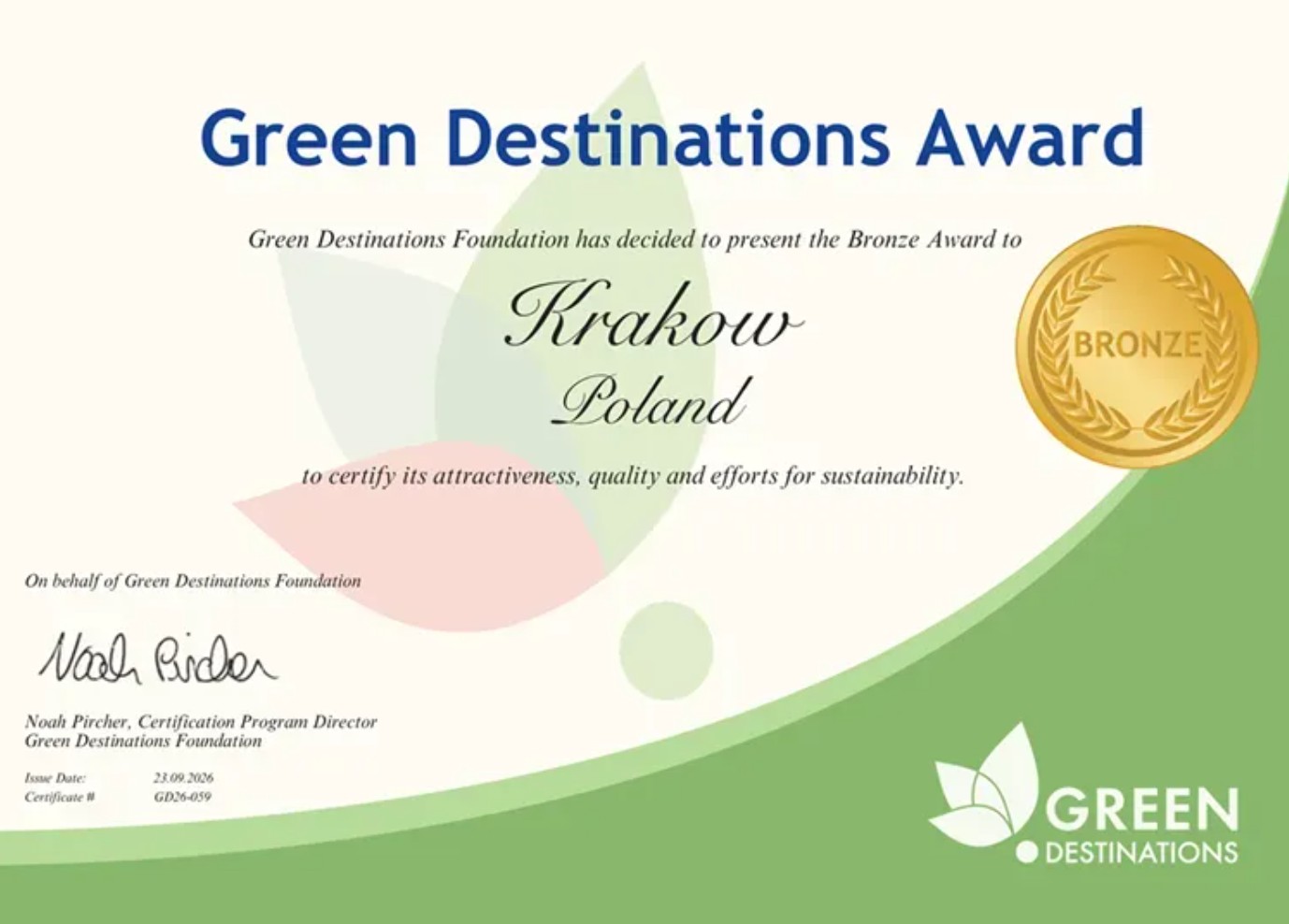
Kraków remains the highest-scoring Polish destination, with 65.18 points compared with 62.16 points in 2025.
The city recorded particularly strong progress in the Social category, where its score increased by 9.9 percentage points. This placed Kraków among the ten destinations with the greatest improvement in this area. The category covers accessibility, inclusivity, safety, health and quality of life, integration of the Sustainable Development Goals, and the relationship between tourism development and the local community.
For Kraków, this year’s result continues the upward trend recorded in previous editions. The city has participated in the GDS-Index since 2022.
Wrocław – second year in the ranking
Wrocław completed the 2026 edition with 43.29 points, compared with 43.81 points a year earlier. The difference is minimal – 0.52 points – making an assessment of individual categories and the development of a longer-term data series more relevant than a simple comparison of the two overall results.
Wrocław has participated in the GDS-Index since 2025. In this year’s summary, it was highlighted among the Polish cities making progress in the Environmental category. This category analyses areas including climate policy, emissions, energy, resource and water management, public transport, air quality and biodiversity.
GDS-Index 2026: from strategy to measurable results
This year’s GDS-Movement report is entitled Spark to Scale. Its central theme is the change that has taken place in destination sustainability management over the past decade. A few years ago, simply having a strategy in place was considered an important indicator of a city’s maturity. In 2026, the emphasis has shifted towards documented results and the ability to implement adopted plans.
The data illustrates the scale of this change. More than 90% of participating destinations now have climate strategies, greenhouse gas emissions commitments and biodiversity-related strategies. Demonstrating the results of their implementation remains considerably more challenging. At the same time, the gap between the Top 10 and the average score across all destinations has narrowed for the third consecutive year, from 20.3 to 14.5 percentage points. Destinations outside the leading group are improving faster than the frontrunners.
What does the GDS-Index measure?
The GDS-Index is a destination benchmarking and improvement programme. In 2026, it uses 74 indicators grouped into four categories:
- Environmental – climate, energy and emissions, circular economy and waste, water, air quality, transport and biodiversity;
- Social – including safety, health, accessibility, inclusivity, resident engagement and implementation of the Sustainable Development Goals;
- Supplier – hotels, airports, PCOs and DMCs, restaurants, conference venues, attractions, universities and other tourism and events sector businesses;
- Destination Management – destination strategy, governance, reporting, certification, skills development, impact measurement, communications, mobility and climate action.
For this reason, the GDS-Index should not be viewed solely as a ranking. GDS-Movement describes it primarily as a tool that allows destinations to benchmark their performance, identify gaps and track change over successive years. Participation itself, or even a high position, does not mean that a destination has become fully sustainable.
GDS-Index 2026 Top 40 – a benchmark for Polish cities
Helsinki leads the 2026 GDS-Index with 92.94 points, followed by Gothenburg with 91.29 and Copenhagen with 90.35. Nordic cities occupy all five of the leading positions, with Aarhus and Aalborg completing the top five. The differences at the top are small. Copenhagen and Aarhus are separated by just 0.23 points, while Reykjavík, with 86.59 points, and Tampere, with 86.35 points, are 0.24 points apart. Edmonton and Flanders occupy the final positions in the Top 40, each with 72.00 points.
No Polish city has yet entered this group. By comparison, Kraków, the highest-scoring Polish destination, has 65.18 points. However, the difference from the current Top 40 threshold should not be regarded as a fixed ‘distance’ to qualification, as scores across the entire group change each year.
This year’s results illustrate that clearly. Bremen improved its score by 22.3 points, Madrid by 19.8 points and Valencia by 17.1 points in a single year.
Why do GDS-Index results matter to the meetings industry?
For congress and event organisers, sustainability data is increasingly becoming part of the destination selection process. The GDS-Index provides a combined view of the city, the way tourism is managed and the performance of local suppliers. It therefore assesses factors directly relevant to event planning – from transport and accessibility to hotels, congress centres, PCOs, DMCs and supplier certification.
The scale of change across the industry can be seen in the data. In 2026, 72.06% of assessed congress venues held sustainability certification, compared with 47.21% in 2023. Over the same period, the proportion of certified hotel rooms increased from 34.26% to 58.63%, while the figure for event agencies rose from 16.86% to 39.05%.
This is one of the reasons why the participation of Polish cities in the GDS-Index also matters for their position in the international meetings market.
Four cities working towards change
Kraków, Gdańsk, Szczecin and Wrocław are at different stages of their work with the GDS-Index. What they share is the use of the same international methodology and the opportunity to benchmark their activities against destinations in other countries.
Poland Convention Bureau is simultaneously supporting the development of sustainability-related expertise within Poland’s meetings sector. In 2026, the Polish Tourism Organisation was a partner of the GDS-Forum & Impact Day in Szczecin. As part of Destination Poland Green Academy 2025–2026, six workshops were also organised in Bydgoszcz, Kielce, Lublin, Poznań, Łódź and Katowice, attended by more than 150 representatives of the MICE industry.
Future editions will show whether the pace of change enables Polish cities to move closer to the Top 40. More important, however, is the process behind the score: cooperation between convention bureaux, city authorities, tourism organisations, venues, hotels, PCOs, DMCs and other local partners, together with the transition from strategies to data demonstrating their results.