For American meeting planners, Europe offers no shortage of familiar destinations. Yet organisations planning leadership summits, international congresses and high-level incentive programmes increasingly need more than a recognisable city and a well-equipped venue. They need a destination connected to the subject of the event itself: a place shaped by economic momentum, international cooperation, talent, innovation and long-term strategic relevance. Poland offers precisely this combination.
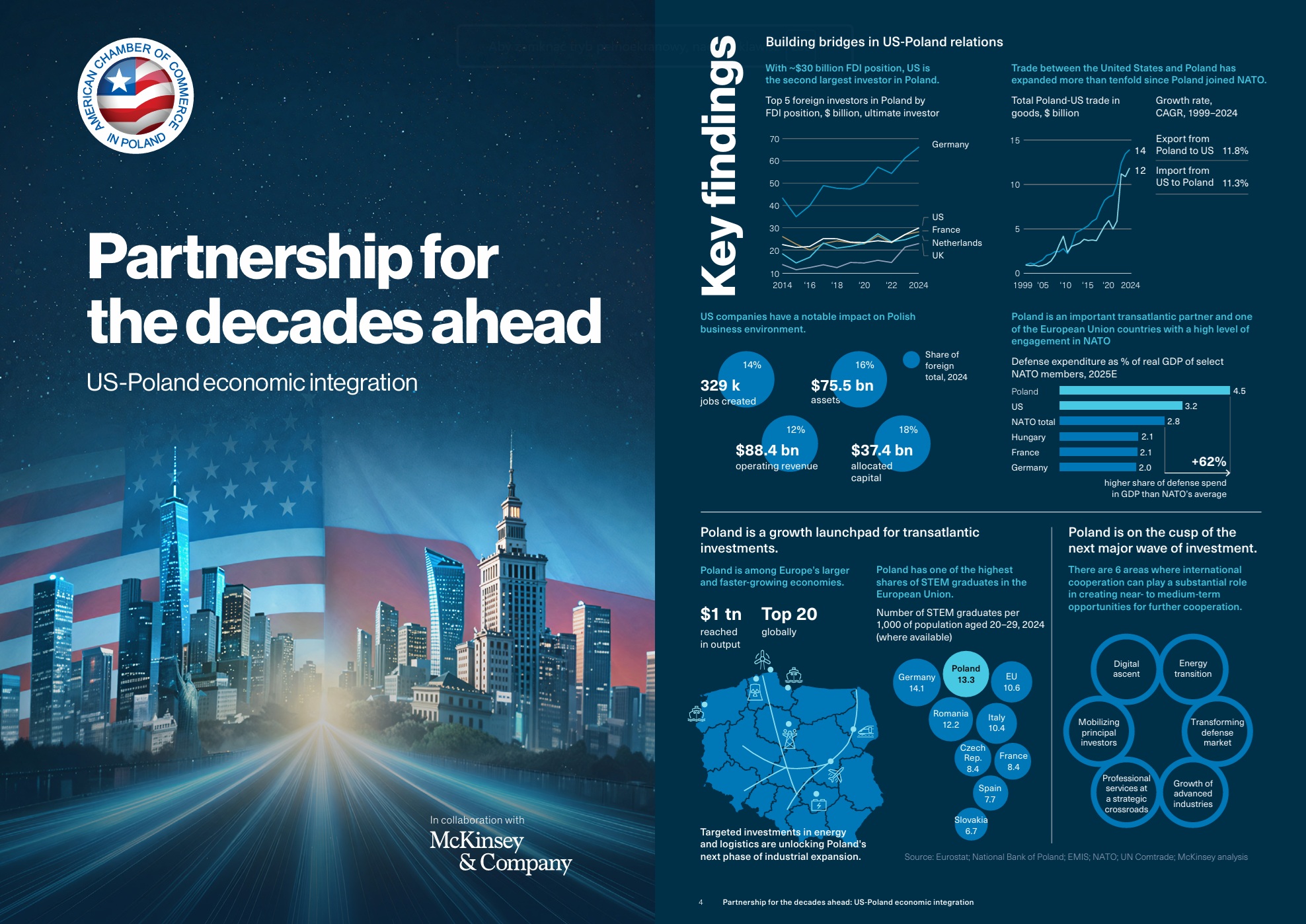
The Partnership for the Decades Ahead: US – Poland Economic Integration Report, prepared by the American Chamber of Commerce in Poland in collaboration with McKinsey & Company, presents Poland as a growing platform for transatlantic business. It describes a country that has progressed from a cost-competitive market into an integrated operating base for regional and global activities.
For event planners, this story provides much more than economic background. It creates content for conferences, access to expertise, opportunities for technical visits and a strong narrative for delegates. Here are five reasons Poland should be part of the conversation when planning the next generation of strategic business events.
1. From emerging market to trillion-dollar economy
Poland is no longer simply an emerging destination in Central Europe. In 2025, its economic output exceeded the symbolic threshold of $1 trillion, placing the country among the world’s 20 largest economies.
Its rise has been sustained rather than temporary. Poland’s GDP per capita has increased almost sevenfold since the beginning of the 1990s. Among the European Union’s larger economies, it was also the only one to maintain uninterrupted growth from 1990 until the COVID-19 pandemic, including throughout the global financial crisis.
For meeting planners, this scale is reflected in the country’s expanding infrastructure, international hotel market, modern conference facilities and increasingly sophisticated professional services.
More importantly, Poland’s transformation offers a powerful intellectual framework for events focused on leadership, resilience, investment, organisational change and economic development. Delegates are not visiting a market standing still. They are entering a country that continues to redefine its role in Europe and the wider global economy.
Poland’s relationship with the United States reinforces that relevance. Trade between the two countries has expanded more than tenfold since Poland joined NATO in 1999.
A conference held in Poland can therefore become part of a much larger story: the development of a transatlantic corridor connecting American capital, technology and expertise with European markets, talent and industrial capacity.
2. Talent that gives conferences intellectual gravity
The long-term impact of a congress or professional conference depends not only on international speakers but also on the knowledge available in the host destination.
Poland has one of Europe’s strongest pipelines of technical talent. Its universities produce approximately 65,000 to 70,000 STEM graduates each year. The country records 13.3 STEM graduates per 1,000 residents aged 20–29, compared with an EU average of 10.6. That result places Poland close to Germany and ahead of several major Western European economies.
This matters directly to organisers of medical congresses, engineering conferences, technology events and association meetings.
Poland offers access to academics, scientists, engineers, physicians, entrepreneurs and technology specialists who can contribute to programmes, support international bids and help create meaningful links between visiting delegates and local institutions.
The country’s talent has also contributed to some of the most recognisable companies in the global technology sector. The report highlights Polish founders and engineers associated with PayPal, Snowflake, OpenAI and ElevenLabs.
Hosting an event in Warsaw, Kraków, Wrocław, Poznań, Gdańsk or another Polish academic and business centre therefore means entering an active knowledge ecosystem – not simply hiring a venue within it.
For meeting planners, this creates opportunities for:
- university and research partnerships,
- local expert participation,
- innovation-focused site visits,
- start-up and technology showcases,
- sector-specific networking,
- and legacy projects extending beyond the event itself.
3. The $30 billion trust factor
American organisations considering Poland are not entering an untested business environment.
More than 1,600 US companies are already active in Poland. Together, they have created approximately 329,000 jobs, hold around $75.5 billion in assets and generate roughly $88.4 billion in annual revenue. Their activities cover manufacturing, professional services, pharmaceuticals, food production, logistics, technology, communications, real estate and defence.
The United States is Poland’s second-largest foreign investor and the country’s largest source of non-EU investment, with an ultimate-investor position of approximately $30 billion.
This established presence can give an American conference organiser access to a mature network of potential partners, speakers, sponsors and corporate hosts.
The nature of US investment is also evolving. Manufacturing remains the largest category, representing approximately 38 per cent of US foreign direct investment, but professional services and technology are expanding rapidly. Professional-services investment almost doubled in 2024 compared with the previous year, while investment in IT and communications increased by 33 per cent.
The strongest evidence may be what happens after US companies establish themselves in Poland. More than three-quarters of the businesses surveyed for the report said they had expanded their Polish operations during the previous five years. Sixty-seven per cent reported that their activities had moved towards more advanced or knowledge-intensive functions.
For event planners, this means Poland can support conversations that extend well beyond market entry. It is a credible location for regional leadership meetings, investor conferences, employee gatherings, product launches, innovation forums and executive programmes focused on Europe’s next phase of development.
4. Regional specialisation creates programme content
One of Poland’s greatest strengths as a meetings destination is that its economic activity is not concentrated in one city.
Warsaw, Kraków, Wrocław, Poznań and the Tri-City (Gdansk, Sopot, Gdynia) are important centres for corporate headquarters, digital operations and professional services. Manufacturing and advanced industrial activity extend across Lower Silesia, Silesia, Greater Poland, Łódź and the Subcarpathian region.
This geographical diversity enables planners to match an event with a city or region whose identity supports its subject matter.
Aviation and engineering
The Aviation Valley cluster around Rzeszów brings together almost 180 organisations involved in manufacturing, engineering and research and development. Its ecosystem includes global aerospace companies and Polish suppliers working on advanced production, engines, components and control systems.
For an aerospace or engineering association, Poland can offer more than a conference hall. It can support technical visits, meetings with manufacturers, university cooperation and direct exposure to an internationally connected industrial cluster.
Technology and professional services
Warsaw, Kraków and Wrocław provide strong environments for technology, business services and digital innovation. Their ecosystems can enrich events concerning artificial intelligence, cybersecurity, fintech, shared services, software development and the future of work.
Advanced manufacturing
Locations such as Wrocław and Silesia allow organisers to combine conference programmes with access to global production and research facilities. The report cites the 3M SuperHub in Wrocław – its largest production centre in the EMEA region—as an example of a facility combining manufacturing, research, innovation and Industry 4.0 projects.
Supply chains and food production
American businesses are also deeply integrated into Poland’s regional economies. The report notes that McDonald’s works with more than 120 Polish suppliers as part of its national network, illustrating the scale of local supply-chain connections.
These examples make it possible to design programmes with substance: business missions, educational tours and site visits that provide delegates with privileged access to the industries being discussed on stage.
5. Cultural alignment without losing the sense of discovery
A successful international event must make participants feel comfortable while still giving them the experience of discovering somewhere new. Poland offers this balance particularly well for American groups.
The relationship between the two countries is rooted in a long history of cooperation and what the report describes as a shared understanding of freedom, trust and common values.
That alignment is also visible in business. American investors surveyed for the report identified Poland’s talent, market potential and cultural fit with US business practices among the factors supporting their presence in the country.
Polish consumers also demonstrate a notably positive attitude towards American products. According to the Ipsos data presented in the report, 40 per cent said they were likely to choose goods produced in the United States -one of the strongest results among the European markets surveyed.
For delegates, however, familiarity does not mean predictability.
Poland combines contemporary business cities with historic districts, UNESCO-listed heritage, regional cuisine, Baltic landscapes, mountain destinations, forests, lakes, castles and revitalised industrial architecture. A corporate summit can be followed by a cultural programme; a technical conference can include an incentive extension; and a leadership meeting can move from an urban innovation centre to a historic or natural setting within the same itinerary.
American participants can therefore operate within a recognisable professional culture while experiencing a destination that still feels fresh, distinctive and memorable.
Poland as a stage for the next transatlantic conversation
The case for Poland is not based on price alone, nor should the country be presented simply as an alternative to Western Europe. Its stronger proposition is strategic relevance.
Poland is a major European economy with a substantial talent base, a mature American business community and regional ecosystems spanning technology, engineering, manufacturing, energy, aviation and professional services. These assets can become part of an event’s programme, partnerships and long-term impact.
In an era when organisations are placing greater emphasis on resilience, innovation, trusted relationships and meaningful content, choosing a destination is no longer only an operational decision. It is also a statement about where an organisation sees the future developing.
Poland offers the infrastructure required to host an international event. More importantly, it offers a reason for that event to take place there.
One country, many possible event stories
Poland does not offer a single event destination. It offers a network of cities and regions with different identities, areas of expertise and delegate experiences.
Warsaw, Kraków, Wrocław, Poznań and the Tri-City are important locations for corporate headquarters, professional services and digital operations. Other regions have developed strong clusters in areas including aviation, automotive production, logistics, electronics and advanced manufacturing.
This allows planners to select a destination that reflects the subject and objectives of their event.
Warsaw can provide the energy of a European capital and major business centre. Kraków combines academic excellence and international business with one of Europe’s most recognisable historic environments. Wrocław offers a strong technology and innovation ecosystem. Poznań brings together entrepreneurship, trade and a long tradition of hosting business events. Gdańsk and the wider Tri-City connect maritime identity, transformation and contemporary urban culture.
Beyond the principal cities, Poland opens the door to incentive programmes involving the Baltic coast, mountains, lakes, forests, castles, industrial heritage, vineyards and regional gastronomy.
This variety makes it possible to combine a congress with an incentive extension, connect two cities within one programme or create contrasting experiences—from boardroom discussions and innovation visits to nature, heritage and local encounters.
More value – and more experience – than expected
Poland combines modern meeting facilities, professional local partners, distinctive venues and diverse destinations with competitive value. Its proposition is not based on being the least expensive option. It is based on the quality and range of experiences that can be delivered within an event budget.
Historic buildings can become gala venues. Former industrial spaces can host creative events. Contemporary conference centres can be paired with walkable city districts, cultural programmes and local gastronomy. Business sessions can be followed by experiences that give participants a genuine sense of place.
This is the idea behind “Poland. More than you expected”: a destination able to combine tradition with innovation, modern hotels and venues with authentic experiences, and strong professional delivery with value for organisers and participants.
Poland’s event community is also investing in more responsible ways of working. Initiatives such as the Destination Poland Green Academy bring together hotels, venues, DMCs, convention bureaux and other industry partners to develop practical approaches to sustainable meetings and incentive travel.
The conversation we want to have in Las Vegas
At IMEX America, our conversation should not begin with: “How many participants are you bringing?”
It should begin with:
- What does your organisation want the event to achieve?
- Does it need to strengthen relationships?
- Introduce delegates to a growing European market?
- Connect business with science and innovation?
- Reward a team with an experience they would not expect?
- Create a programme with a credible legacy for the host destination?
Once we understand the objective, we can discuss the Polish city, venue, partners and experiences that will help deliver it.
IMEX America 2026 takes place from 13 to 15 October at the Mandalay Bay Convention Center in Las Vegas. Poland Convention Bureau will be there to discuss conferences, corporate meetings, association congresses and incentive programmes – and to show why Poland is not simply another European option.
Is your next event taking place in a destination that reflects the past – or one actively shaping the future?