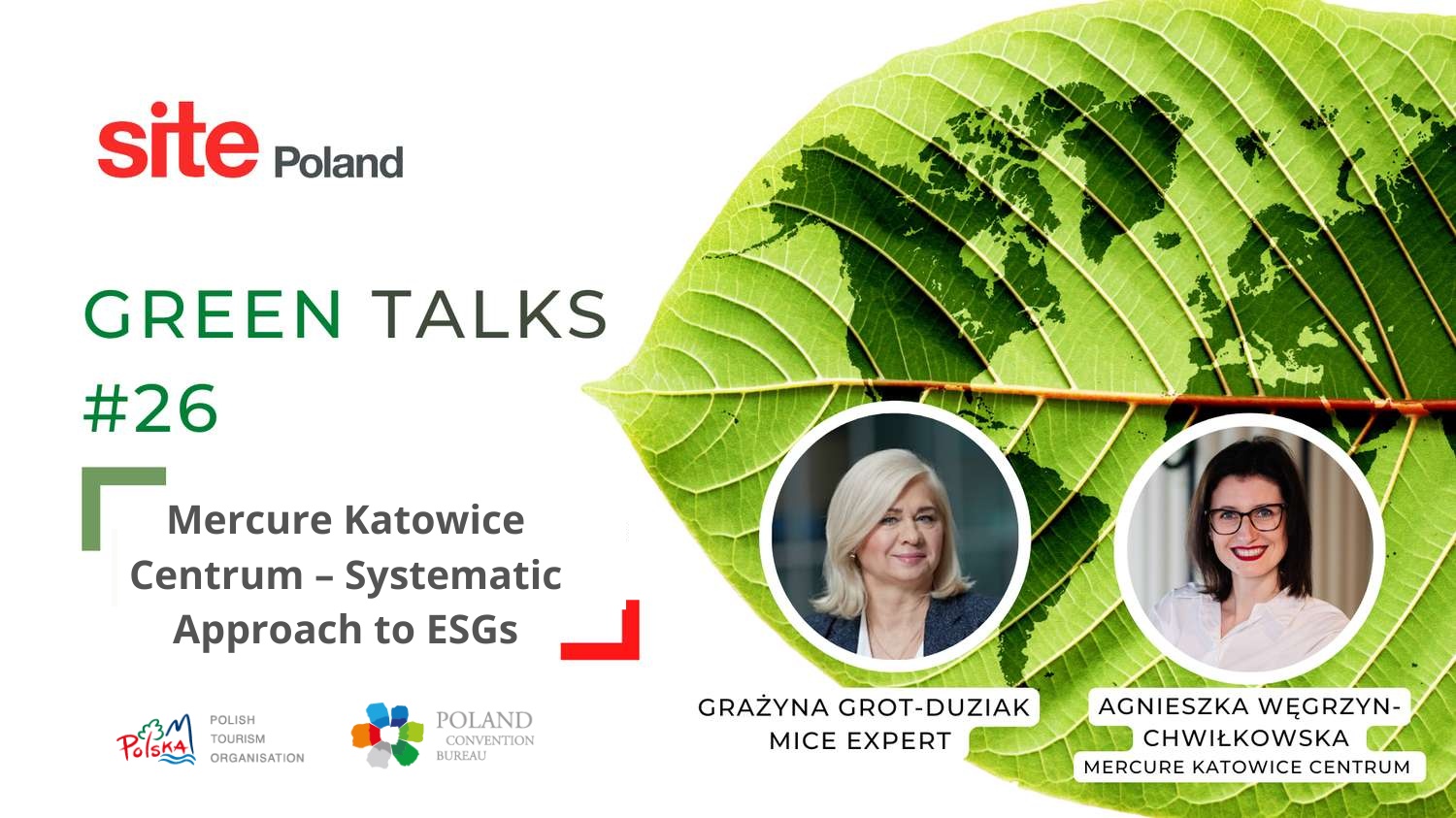
Mercure Katowice Centrum hotel shows how sustainability can be embedded into everyday hotel operations rather than treated as a separate initiative. In this Green Talks interview, Agnieszka Węgrzyn-Chwiłkowska discusses with Grażyna Grot-Duziak the hotel’s ESG approach, certifications, operational solutions and the growing impact of sustainability on business events and client expectations.
Grażyna Grot-Duziak: Mercure Katowice Centrum is often cited as one of the leaders in sustainable hospitality in Poland. Where did your journey towards operating the hotel in a more responsible way begin? What values and objectives guide the hotel in implementing its ESG and sustainability strategy?
Agnieszka Węgrzyn-Chwiłkowska: Our journey began at the hotel design stage. From the outset, we wanted Mercure Katowice Centrum to become part of the city’s transformation – from an industrial centre into a modern, green city.
We describe our approach as “Green & Clean”. It is not a single project or a set of individual initiatives, but a way of managing the hotel that encompasses environmental issues, social relations and the organisation of work. We treat ESG as an integral part of the business, rather than an additional element of our strategy.
Certifications are an important endorsement of your sustainability credentials. Which certifications and distinctions have you achieved so far?
First and foremost, we hold Green Key, one of the most important sustainability certifications in the hospitality industry today, as well as LEED Platinum certification in the Building Design and Construction category. We have also received a number of industry awards, including recognition as the best ecological building and the “Green Venue” distinction at the MP Power Awards.
What was the greatest challenge during the certification process and the implementation of the required standards?
The greatest challenge was balancing three elements: environmental responsibility, guest comfort and operational efficiency. There is no room for compromising on quality in hospitality, so every solution has to be carefully considered and work effectively in day-to-day hotel operations.
Another challenge is that ESG requires a systemic approach. It is not about individual decisions, but about changing the way the entire team thinks and works.
What benefits have the certifications brought to the hotel?
Above all, certifications help us organise processes and standardise our activities. They also provide credibility, particularly when working with business clients.
From an operational perspective, they bring tangible benefits as well, including better control over utility costs and more efficient resource management.
Which environmental initiatives implemented at the hotel do you consider the most effective?
At Mercure Katowice Centrum, there is no single “flagship” ESG initiative. Instead, we have an entire ecosystem of measures which, together, create an impact. I strongly believe in consistency and in the cumulative scale of small decisions – these are what ultimately make the greatest difference.
In practice, this includes:
- eliminating single-use plastics through solutions such as larger toiletry containers, water dispensers and a more conscious approach to gifts,
- actively combating food waste through food waste measurement and adapting menus to actual needs,
- reducing paper consumption through electronic reporting, fewer printed materials and menus printed on paper made from seaweed,
- monitoring energy and water consumption,
- investing in renewable energy sources,
- engaging guests in environmentally responsible initiatives.
Our “Housekeeping on Request” programme demonstrates that sustainability does not have to be imposed – it can be an invitation to work together.
We do not focus solely on declarations. What matters most to us are the trends and the direction of travel: are we consuming less, are we producing less waste, and are we operating more consciously? These are questions we ask ourselves every day.
How do you monitor progress and assess the effectiveness of these initiatives?
We use advanced utility monitoring systems, including an intelligent BMS (Building Management System), as well as reporting tools within the Accor structure, which also cover food waste measurement. We regularly analyse the data and implement corrective measures where necessary.
Do the solutions you are implementing also influence the organisation of events and business meetings held at the hotel?
Yes – and this is becoming increasingly evident, both operationally and strategically. In recent years, ESG has moved from being an additional element of an event offer to something that genuinely shapes the way events are designed and delivered.
From the hotel’s perspective, we can see this change very clearly. Clients – particularly corporate clients – increasingly have specific sustainability guidelines. These concern areas such as reducing CO₂ emissions, waste management, eliminating single-use plastics and choosing local suppliers.
ESG therefore influences virtually every element of an event:
- catering, including local products, seasonality and reducing food waste,
- space management, with fewer printed materials and greater use of digital solutions,
- logistics, including transport and optimisation of energy consumption,
- as well as the way an event is reported after it has taken place.
Measuring and reporting an event’s carbon footprint is also becoming increasingly common. For many companies, particularly those organising international events, this is already becoming standard practice.
ESG is also increasingly influencing the decision about which hotel to select for an event.
How did employees respond to the introduction of successive sustainability initiatives? Is the team keen to become involved in environmental and social activities?
The team responded positively, largely because from the very beginning we explained the purpose behind the initiatives rather than simply introducing new procedures.
Employees are keen to take part in environmental and social activities, particularly practical ones such as zero-waste initiatives and local community projects. We also see ideas emerging from within the team itself, which is a very important signal for us.
We focus on education and everyday communication, demonstrating the tangible impact of our actions. As a result, ESG is not perceived as an “obligation”, but as part of our organisational culture.
Employees participate in a wide range of social initiatives. Working with municipal organisations, every year we take part in clean-up activities across the city. Team members volunteer for these initiatives and emphasise that having the opportunity to make a tangible difference to their surroundings is important to them.
At the initiative of our employees, the hotel also became involved in Wielka Orkiestra Świątecznej Pomocy, donating vouchers for charity auctions and enabling guests to contribute to the fundraising campaign.
The team also initiates charitable activities, including donating bed linen and towels to women and children in need. We regularly support animal shelters and local charity initiatives as well.
Cooperation with local suppliers, organisations and communities is an important part of sustainability and of developing the hotel’s offer. From the moment guests enter the hotel, it is clear that local identity is part of your DNA…
One expression of our commitment to the local community is the mural in the hotel lobby, created by local artist Mona Tusz. It references a work she created on the Katowice City Hall building for the United Nations Climate Change Conference held in Katowice in 2018.
The artwork in the guest rooms was also designed by the same artist.
The hotel interiors reference the region in a number of ways, including a motif inspired by Katowice’s iconic Spodek arena near the reception area and the colour schemes used in the rooms, which reflect the city’s transformation.
Local identity is also strongly present at Winestone Katowice restaurant – in the à la carte menu, the conference catering offer and the breakfast selection.
Looking ahead, I understand that the hotel intends to continue implementing further sustainable solutions?
Yes. We plan to continue optimising energy and water consumption and to further develop our initiatives aimed at reducing food waste. ESG will remain one of the key elements of our strategy.
Which trends related to ESG and responsible hospitality do you believe will have the greatest impact on the hotel and MICE industries?
The trend that will have the greatest impact on both the hospitality industry and the MICE sector in the coming years will, above all, be decarbonisation. This means real pressure to reduce CO₂ emissions, both at venue level and in relation to the events being organised. An increasing number of companies are not only declaring such objectives, but also requiring their partners, including hotels and conference venues, to deliver against them.
Another important trend is the growing significance of ESG reporting. Companies need concrete data – not only information about initiatives, but also measurable indicators. This means hotels need to be prepared to collect, analyse and share data on energy consumption, emissions and waste, particularly in the context of business events.
We are also seeing a clear increase in the expectations of business clients. ESG is becoming part of procurement policies and a criterion for selecting partners. Clients expect not only certifications, but above all concrete solutions and consistency in the way sustainability commitments are implemented.
There is also an increasing emphasis on authenticity. The market is very quick to identify superficial initiatives, which means avoiding greenwashing is becoming essential. What matters is not only what a hotel communicates, but above all what it actually does and what results it achieves.
What advice would you give to hotels that are only beginning their journey towards a more sustainable operating model?
The most important thing is to start and to remain consistent. There is no need to begin with major investments – small, everyday decisions and the engagement of the team can make a significant difference.
And finally, if you had to give one reason why investing in sustainability is worthwhile, regardless of the size of a hotel, what would it be?
Sustainability is no longer a choice. It is becoming a business necessity – both from the perspective of clients and for the future of the industry as a whole.
Thank you for the conversation. Grażyna Grot-Duziak SITE Poland, MICE Expert\
Read also:
- Green Talks – The “Green Events” Strategy at Grupa MTP
- Green Talks – Lublin Conference Centre’s ESG Strategy
- Green Talks – Poland Premium with WOWland: Authenticity in the Spirit of Sustainability
- Green Talks – A Boatman’s Passion on the Vistula River