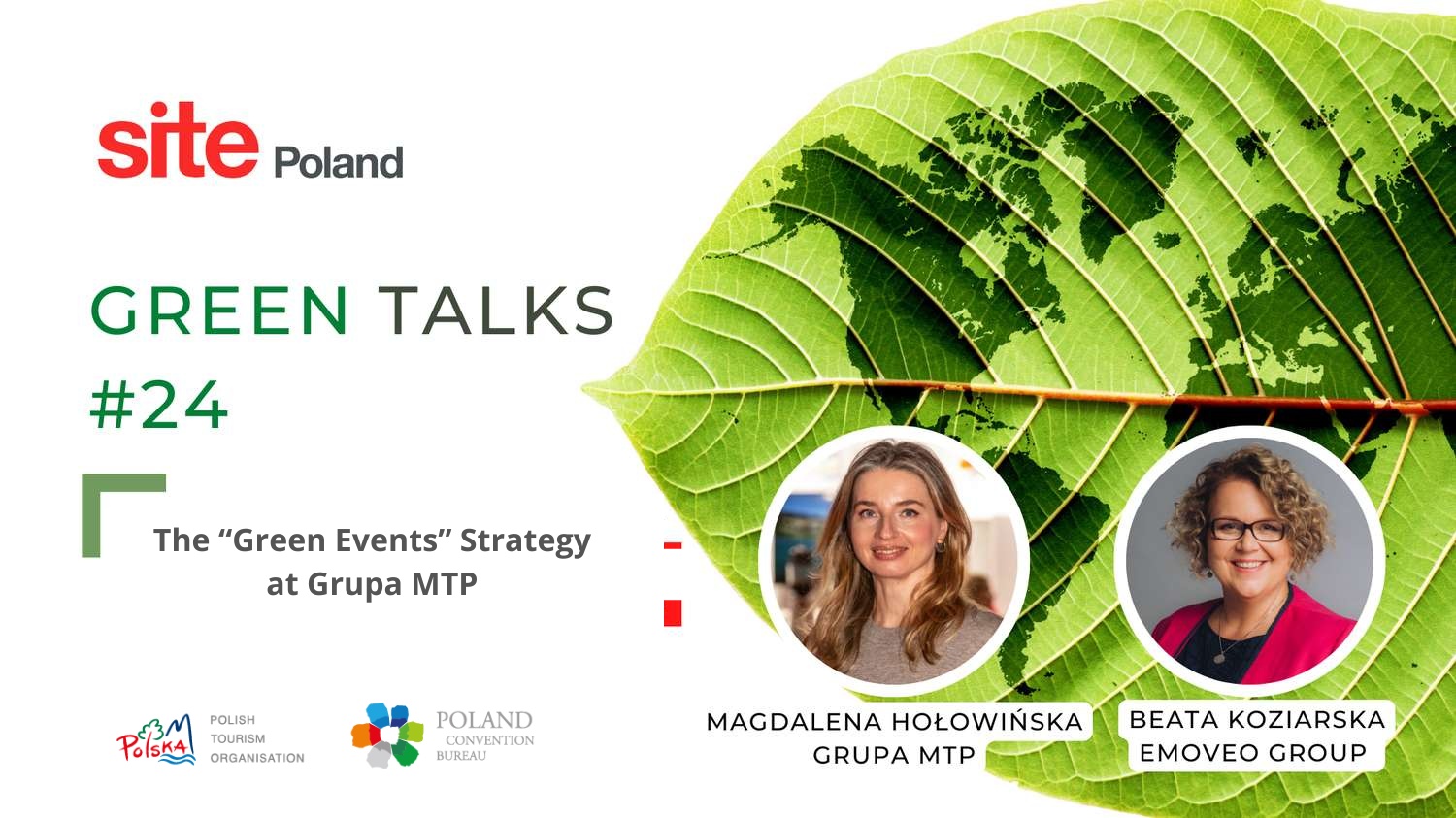
In the latest edition of the Green Talks series, Beata Koziarska of SITE Poland explores the “Green Events” strategy implemented by Grupa MTP in conversation with Magdalena Hołowińska, Conference and Trade Fair Sales Acquisition Team Manager at Grupa MTP and Vice-Chair of the ICCA Central European Chapter.
Sustainable development in the MICE industry is no longer merely an image-building element; it is becoming one of the fundamental criteria of professional event organisation. An increasing number of international associations, corporate clients and congress organisers expect not only the implementation of pro-environmental measures, but also their measurement, reporting and continuous improvement. One example of this approach is the “Green Events” strategy implemented by Grupa MTP.
Magdalena Holowinska
From the beginning of her career, she has been involved in promoting Poland internationally as a destination for projects in the meetings industry. She specialises in attracting scientific congresses and working with national and international associations. For more than 16 years, she has been developing her expertise while representing a wide range of meetings industry stakeholders, acting both as a client and as a service provider, including CVBs, hotels, congress and exhibition centres and PCOs, and promoting four different destinations in Poland – Warsaw, Poznań, Lublin and Warmia and Mazury. Since June 2025, she has served as Vice-Chair of the ICCA Central European Chapter.
ICCA CEC Meeting in Poznan
Beata Koziarska: Magdalena, during the Destination Poland Green Academy educational workshop in Poznań, organised by Poland Convention Bureau / Polish Tourism Organisation in cooperation with SITE Poland, you presented a good-practice example related to the delivery of the ICCA Central European Chapter Meeting. The meeting took place at the Poznań International Fair venue (Grupa MTP) and brought together 77 MICE professionals from 20 CEE countries. Instead of focusing solely on the programme, showcasing Poznań as a destination to international guests and ensuring comfort, you decided to measure the event’s carbon footprint. Where did this decision come from and why, in today’s reality, is simply “being eco-friendly” no longer enough, while robust data reporting has become necessary?
Magdalena Hołowińska: Measuring the carbon footprint of the ICCA Central European Chapter Meeting was, above all, a response to the client’s needs. ICCA has for many years placed a very strong emphasis on sustainability in the organisation of its events. As a result, most participants – members of the association – are highly aware of the importance of sustainable practices and actively support activities undertaken in this area.
This made the process much easier for us, both at the programme preparation stage and when collecting the data required to calculate the event’s carbon footprint. Participants understood the purpose of these activities and were willing to engage in the process, which significantly influenced the quality of the information collected.
When it comes to data reporting, we see it as an extremely valuable tool for organisers. It is specific indicators that allow us to assess which sustainable solutions genuinely deliver results, as well as what environmental and economic benefits they generate. Hard data enables decisions to be made on the basis of facts, rather than declarations or good intentions alone.
Reporting means that “being eco-friendly” ceases to be merely a marketing slogan and becomes a set of specific operational measures that can be measured, analysed and improved. Moreover, many of these solutions also translate into more effective event budget management, demonstrating that sustainability and business efficiency can go hand in hand.
For us, this was also important from the perspective of building credibility. We want not only to talk about sustainability, but also to present concrete results and take responsibility for reporting them. We believe that this direction – based on measurable data and transparency – will become the standard in the events industry in the coming years.
What role does environmental transparency play in Grupa MTP’s strategy? Is measuring impact a response to real market needs, or rather an internal mission to educate the MICE industry?
For us, as an organisation employing more than 400 people, environmental transparency is, on the one hand, a response to growing regulatory requirements, including EU legislation, and, on the other, to real market needs. Today, most requests for proposals relating to the organisation of international congresses and conferences include sustainability-related requirements. This is no longer an added value, but a standard that clients expect from professional event organisers.
At the same time, I believe that the MICE industry itself is now largely aware of the challenges associated with sustainability. Increasingly, the challenge is not to educate organisers or suppliers, but to support clients in the process of implementing new solutions. Many of them are accustomed to specific event delivery models or are concerned about how participants may respond to change.
A good example is the gradual shift away from traditional catering towards vegetarian menus at major international congresses. In the case of events bringing together more than 10,000 participants, some associations needed several years to successfully implement such a solution and convince their stakeholders to support it. This shows that the transformation towards more sustainable events requires not only the right organisational decisions, but also the building of acceptance and a change in habits.
We adopted a similar approach during the ICCA Central European Chapter Meeting. We decided to offer vegetarian catering on the first day of the event, treating this as a sensible compromise between our sustainability ambitions and the potential expectations of participants. Such gradual implementation of change often proves to be the most effective route to achieving lasting results.
How do the stages of creating a “measurable” event differ from standard conference planning? Did this process require the involvement of different teams or experts than usual? What are the key stages in creating such an event?
In our case, preparing a “measurable” event did not differ radically from the standard conference organisation process, but it did require the inclusion of an additional stage related to data collection and analysis. It was also crucial to involve an external partner specialising in carbon footprint reporting, who helped us define the scope of information required and the methodology for analysing it.
On the organiser’s side, the biggest challenge was adapting existing tools and processes to collect the data needed to calculate the carbon footprint. For example, we expanded the registration form to include additional questions about participants’ travel methods, departure points and means of transport used. Equally important was cooperation with event partners, whom we informed already at the preparation stage about the scope of data that would be required for reporting, for instance regarding the sustainable solutions they applied.
The key stages in creating such an event include, first and foremost, defining the scope of measurement, preparing data collection tools, cooperating with suppliers and partners, and then analysing the information gathered and preparing the final report.
It is worth emphasising, however, that as a congress and exhibition venue, we monitor a great deal of data on an ongoing basis, regardless of any specific event. We regularly analyse energy and utilities consumption, facility operating costs and the volume of waste generated. We also take action to reduce food waste – after trade fair events, surplus food from MTP Cafe outlets is donated to public benefit organisations. As a result, some of the processes necessary for reporting had already been implemented in our day-to-day operations.
Working exclusively with local partners was a key element of this project. Does such an approach simplify logistics, or does it, on the contrary, narrow the scope of options and require greater creativity from the organiser?
From our perspective, working with local suppliers, especially those with whom we have long-standing relationships, definitely simplifies event organisation. Above all, they know our venue, its possibilities and limitations very well, which means they can respond more quickly to emerging needs and carry out their tasks more efficiently.
Another major advantage is the experience gained during previous projects. Together, we have gone through many different, often unforeseen situations, so we know which solutions work best in practice. This translates into greater flexibility and a stronger sense of security on the organiser’s side.
This does not mean, however, that creativity is no longer needed. Quite the opposite – in the events industry, creativity is indispensable, because every event is different and presents organisers with new challenges. Crisis situations rarely repeat themselves in exactly the same form, so the ability to react quickly and find non-standard solutions remains crucial.
Locality also gives us an additional operational advantage. Shorter supply chains mean a faster response time, easier communication and greater flexibility, including in situations requiring sudden changes or the replenishment of catering shortages. Supporting the local economy is also significant. Cooperation with companies from the region not only helps reduce the environmental impact of transport, but also strengthens the local business ecosystem of which we ourselves are part.
It is often assumed that sustainability in MICE is an additional logistical burden. From your perspective, was the implementation of solutions such as eliminating plastic or optimising air conditioning troublesome, or did it, paradoxically, improve certain processes?
From our perspective, implementing sustainability-related solutions is not an additional logistical burden. As a venue offering a wide range of in-house services, such as catering, AV and IT, we very often see them as an element of process and cost optimisation. The benefits are felt both by event organisers and by us as a service provider. In many cases, pro-environmental measures go hand in hand with greater operational efficiency, reduced waste and better use of resources.
A good example is the activity of our company IDEA Expo, which offers different types of exhibition stand construction with varying environmental impacts. One of the most sustainable solutions is the OCTANORM system, based on reusable elements and allowing for almost complete recovery of materials after an event. This significantly reduces both the amount of waste and the carbon footprint associated with the production of new elements.
At the same time, the final choice always rests with the client. In practice, decisions are often the result of a compromise between environmental aspects, budget and the expected visual effect. Modular systems such as BeMatrix are also very popular, with the structure being used repeatedly, while some finishing materials, such as printed textile graphics, are single-use. The least sustainable solution remains custom-made carpentry-based stand construction. Although it offers the greatest design and aesthetic possibilities, once the event is over, its elements often do not find further use unless the client decides to collect them and use them in another project.
This shows that sustainability in the MICE industry is not only about eliminating certain materials or technologies. Above all, it is about making informed decisions and choosing solutions that make it possible to achieve the event’s objectives with the lowest possible environmental impact.
Vegan catering and local products mean a low carbon footprint (8.0% of the total), but they are often a challenge for traditional habits. Was the implementation of a plant-based menu logistically “friendly” for the organiser and how did it affect supply planning?
Preparing a plant-based menu itself is no longer a major logistical challenge. The habits and expectations of event participants play a much greater role. In our case, it was relatively easy to implement, because the event was organised for members of ICCA – a group that is highly aware of sustainability issues and open to this type of solution.
Introducing fully plant-based catering would probably be a greater challenge at events aimed at other target groups, where participants are more attached to a traditional, meat-based diet. That is why I believe that, in the case of catering, sustainability does not always mean choosing extreme solutions. Often, it is more important to find a balance between reducing environmental footprint, meeting participants’ expectations and supporting the local economy.
In Wielkopolska, which is one of Poland’s most important regions for meat production and processing, there is an additional aspect to consider. One may ask what is, in practice, more sustainable: completely abandoning meat products or offering a limited meat-based menu sourced from local suppliers, while at the same time increasing the share of plant-based dishes. This shows that sustainability often requires taking local context into account and looking beyond the analysis of a single indicator.
From the perspective of supply planning, plant-based catering can even simplify some processes, especially when it is based on seasonal and local products. However, the key is to properly prepare participants for such a change and gradually build acceptance of new solutions. The experience of organisers of major international congresses shows that a transition to 100% vegetarian catering usually does not happen immediately. Most often, it is a process spread over several years, implemented in stages and preceded by dialogue with participants and event organisers.
The ICCA CEC in Poznań involved 77 people. Can the reporting and reduction mechanisms that worked here be directly transferred to large-scale trade fairs or congresses with thousands of participants?
Absolutely. The mechanisms related to reporting and reducing environmental impact can be successfully transferred to events with thousands of participants. What is more, it is precisely at large congresses and trade fairs that the potential benefits of implementing sustainable solutions are greatest.
This is confirmed by the experience of organisers of major international events, such as the congress organised by WindEurope, which attracts around 16,000 participants, or the conference of the European Association for International Education (EAIE), attended by around 7,000 people. These organisations have for years been implementing sustainability-related measures, including environmental impact reporting, waste reduction, cooperation with local suppliers and the introduction of catering based entirely on plant-based products.
Of course, as the scale of an event increases, so does the complexity of data collection and the coordination of activities. This does not change the fact that the basic principles remain the same. The key factors are proper planning, cooperation with partners and consistent data collection, which make it possible to measure the effects of actions taken and gradually improve subsequent editions of the event.
What lessons from this relatively small event do you intend to implement in the largest projects delivered at MTP in order to achieve the stated target of reducing emissions per participant by 30%?
The most important lesson learned from organising the ICCA Central European Chapter Meeting is that effective emissions reduction requires, above all, reliable data. Only measurement makes it possible to identify the areas that have the greatest impact on an event’s carbon footprint, and then to make decisions based on facts rather than assumptions.
In the case of ICCA CEC, we also became convinced that many solutions considered “eco-friendly” not only do not make event organisation more difficult, but actually improve operational processes. This applies, among other things, to working with local suppliers, reducing waste and gradually increasing the share of plant-based menus in catering. These are measures that can be scaled and implemented during the largest events organised at the MTP venue.
At the same time, the project showed how important cooperation is among all participants in the process – the organiser, the venue, suppliers, partners and the participants themselves. Achieving the target of reducing emissions per participant by 30% will not be the result of one spectacular change, but of a series of smaller decisions made at every stage of event preparation.
In future projects, we primarily want to develop our data collection system, increase the share of local suppliers, promote solutions based on the circular economy, such as the repeated use of stand construction elements, and gradually implement catering solutions with a lower carbon footprint. Engaging clients and participants in this process will be equally important, because international market experience shows that the most lasting changes are achieved when they are introduced in stages and communicated to all stakeholders well in advance.
Are we ready for “green logistics” to become a Polish standard, a distinctive Polish differentiator in the perception of Poland as a “Green Destination”? What stage are we at, what are the opportunities and what are the challenges?
I think that, unfortunately, we are no longer at the stage where green logistics can serve as a differentiator for our destination. For international event organisers, sustainability-related solutions are becoming a standard rather than a source of competitive advantage. In addition, EU regulations related to ESG are playing an increasingly important role, making the implementation and reporting of environmental measures simply part of responsible business conduct.
For this reason, I believe that Poland is currently at a stage of catching up with the most advanced European markets rather than setting the direction of change. This does not mean, however, that we are in a bad place. Our industry is developing very rapidly, awareness among organisers, venues and suppliers is growing, and more and more events are taking environmental aspects into account already at the planning stage.
The greatest opportunity lies in using this moment to build competences and implement solutions based on measurable data. Increasingly, it is no longer enough to declare that an event is “green” – one must be able to demonstrate specific indicators, results and progress. Transparency and the ability to report will be crucial in the coming years.
The greatest challenge, however, remains changing the habits and expectations of all market participants – from organisers and suppliers to event participants themselves. The experience of the largest international congresses shows that even seemingly simple changes, such as reducing meat products or implementing new standards of resource management, are processes spread over years. Success will therefore depend not on individual initiatives, but on a consistent and long-term approach by the entire industry.
Thank you very much for these valuable insights.
Beata Koziarska, SITE Poland, Expert of the Destination Poland Green Academy workshops.
Interviewee: Magdalena Holowinska