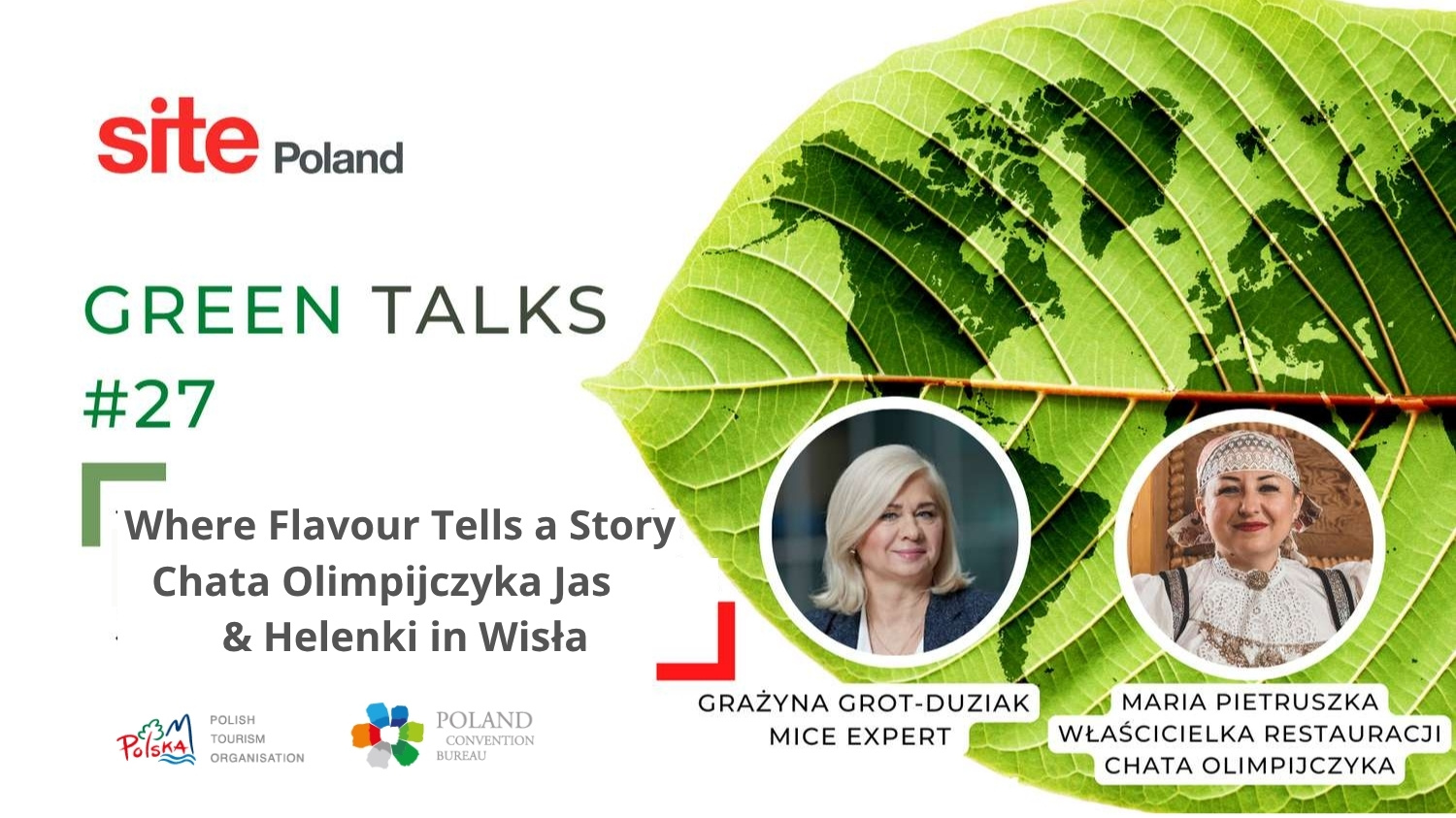
At Chata Olimpijczyka Jasia i Helenki in Wisła (Silesia), local cuisine is about much more than food. Family recipes passed down through generations, regional produce, cooperation with local partners and responsible business practices all form part of the restaurant’s identity. In this Green Talks interview, Grażyna Grot-Duziak speaks with owner Maria Pietruszka, a participant in the Destination Poland Green Academy workshops, about authenticity, sustainability and how food can tell the story of a destination.
Grażyna Grot-Duziak: Maria, the moment you step inside Chata Olimpijczyka, you immediately sense that this is a place with a story. How did that story begin, and how does your family heritage influence what is served to your guests today?
Maria Pietruszka: Our story began many generations ago. The recipes we still use today date back to my great-great-grandmother, who raised my grandmother Aniela. She ran one of the first canteens in Wisła and passed on to our family not only her recipes, but also a deep respect for tradition and hospitality.
Today, every dish we serve is part of that story. We want our guests not only to enjoy good food, but also to discover the flavours of the Beskids and the family values that have been the foundation of this place for generations.
Many people visit Wisła specifically to discover its authentic flavours. What allows your cuisine to remain faithful to tradition while also meeting the expectations of today’s guests? Are there any dishes you are particularly proud of?
We believe that tradition does not need a revolution – it needs respect. That is why we cook according to family recipes and use regional ingredients, while at the same time paying close attention to the quality of our products and the way dishes are presented.
This enables us to offer our guests authentic flavours in a contemporary form. A particularly special place on our menu belongs to kapuśnica po wiślańsku, a traditional Wisła-style cabbage soup. The recipe has been in our family for more than 150 years and has become a symbol of local culinary heritage.
We are also seeing that more and more people are consciously looking for exactly these kinds of stories and flavours – authentic, genuine and deeply rooted in the place they come from.
Behind every dish there is not only a recipe, but also people and local producers. How do you work with regional suppliers, and why is this cooperation so important both for the restaurant and for the wider region? Are guests increasingly asking about where products come from and the stories behind them?
We have worked with local producers for many years because we know that some of the best products are created close to home. This allows us to serve fresh, high-quality ingredients while supporting regional entrepreneurs at the same time.
It benefits everyone – the restaurant, the producers and the entire local community.
We are also increasingly seeing that guests want to know where products come from and what stories lie behind them. For them, it is no longer only the dish itself that matters, but also the people who create it and the place it comes from.
Chata Olimpijczyka has been part of the local community for many years. How do you engage with the region and promote the culture of the Beskids? Which initiatives best demonstrate that cuisine can act as an ambassador for a destination?
We have always tried to be an active part of the local community. We take part in events that promote the culture and traditions of the Beskids, one of the most important being Tydzień Kultury Beskidzkiej, the Beskid Culture Week.
It is a unique opportunity to demonstrate that regional cuisine is a living part of our identity.
Our regional food truck also plays an important role. We take it to different locations across Poland, serving traditional dishes, telling the story of Wisła and encouraging people to visit our region.
In this way, cuisine becomes one of the best ambassadors for local heritage.
Responsible tourism is becoming an increasingly important topic. How does your cooperation with local partners help create authentic experiences for visitors while also supporting the development of the region?
We believe that responsible tourism is built through cooperation. That is why we join forces with local producers, guides and other partners who help us tell the story of our region.
A good example is the events organised at the Muzeum Wiślańskiej Kuchni Regionalnej, where traditional meals are accompanied by stories from guides about the history of Wisła and the Beskids.
As a result, our guests not only taste the local cuisine, but also discover the culture and the people who create it. It is an experience that stays with them for a long time.
Today, sustainability is about much more than a fashionable slogan. What does it look like in the day-to-day operation of Chata Olimpijczyka? Which environmental solutions have you implemented, and which of them have delivered the greatest impact?
For us, sustainability means making everyday decisions with the future in mind. We use local and seasonal products, work to reduce food waste, separate waste and continually look for ways to minimise our environmental impact.
We cooperate with the Too Good To Go app, which helps ensure that perfectly good meals do not end up being thrown away. We have also invested in a photovoltaic installation with energy storage, energy-efficient equipment and drinking water dispensers.
Each of these measures may seem relatively small on its own, but together they form a consistent philosophy of responsible business management.
Introducing responsible practices also brings challenges. What difficulties do you face in your day-to-day operations, and do you find that guests increasingly appreciate the environmental solutions introduced at the venue?
The greatest challenge is finding the right balance between running the restaurant efficiently and consistently implementing environmentally responsible practices. It requires good planning, the commitment of the entire team and, quite often, additional organisational changes.
However, we can see that guests are increasingly paying attention to environmental solutions. They ask about local products, how we reduce waste and what actions we take to protect the environment. This shows that responsible practices are becoming an increasingly important factor when people choose where to visit.
The success of these initiatives depends above all on people. How do you build a sense of responsibility for the environment and the local community among your employees? What role does the team play in putting this philosophy into practice?
People are the greatest strength of our business. We regularly talk with the team about sustainability, look for new solutions together and remind one another that even small everyday decisions matter. As a result, environmental responsibility is not treated as an obligation, but as a natural part of the way we work. It is the commitment of our employees that ensures the solutions we introduce genuinely work in practice.
Maria, looking to the future, which changes in gastronomy and tourism do you believe will be the most important?
I believe the future will belong to authentic places built around local products, responsible practices and increasingly conscious guests. Reducing waste, saving energy and supporting local communities will become increasingly important.
What advice would you give to owners of other venues who would like to develop their businesses in a more sustainable way?
For those who want to begin this journey, my main advice would be to start with small steps. There is no need to change everything immediately. It is worth gradually developing cooperation with local suppliers, educating the team and consistently implementing solutions that have a real impact on the environment.
Finally, if your guests were to remember just one thing about their visit to Chata Olimpijczyka Jasia i Helenki years from now, what would you want that lasting memory to be?
Above all, I would like them to remember the authenticity. I would like them to remember the flavours created from family recipes, the warm atmosphere and the people whose passion shapes this place.
If, after leaving Wisła, they retain the feeling that tradition, local culture and coming together around a shared table have genuine value, we will feel that we have succeeded in giving them something much more meaningful than simply a good meal.
Flavour, atmosphere, family history and the values that have shaped this place for generations are undoubtedly among the restaurant’s greatest strengths. I wish you and the entire team continued growth, satisfied and loyal guests, and great satisfaction from everything you do.
Thank you for the conversation. Grażyna Grot-Duziak SITE Poland, MICE Expert
Read also:
- Green Talks – The “Green Events” Strategy at Grupa MTP
- Green Talks – Lublin Conference Centre’s ESG Strategy
- Green Talks – Poland Premium with WOWland: Authenticity in the Spirit of Sustainability
- Green Talks – A Boatman’s Passion on the Vistula River