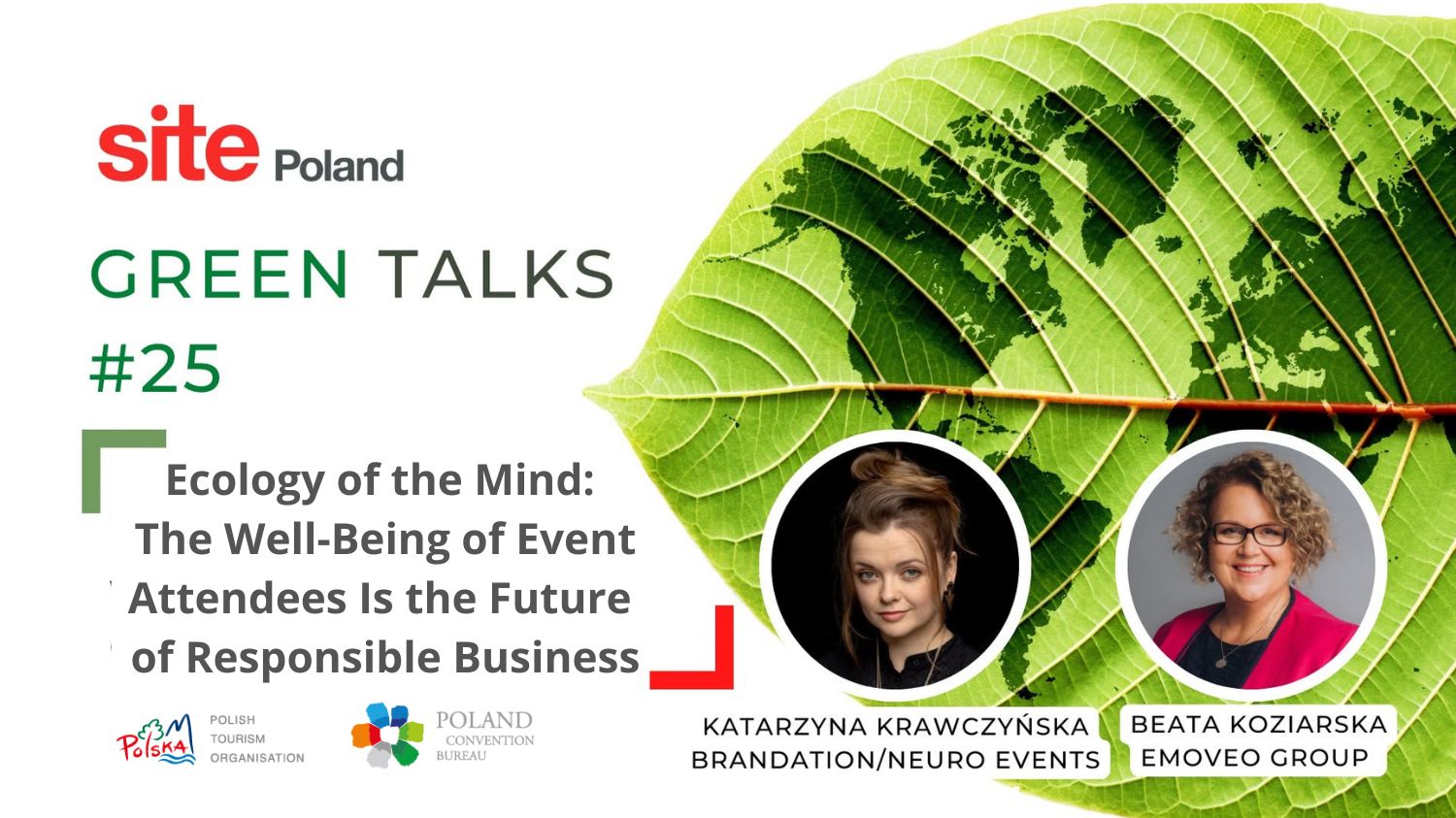
In the 25th edition of the Green Talks series, Beata Koziarska of SITE Poland explores the theme of ecology of the mind and participant wellbeing in conversation with Katarzyna Krawczyńska. The discussion focuses on why designing events with respect for human cognitive needs, sensory comfort and regeneration is becoming an essential element of responsible business and the future of the meetings industry.
For decades, the meetings industry has operated on the assumption that a good event is an intensive event. After many years of working with clients, I can clearly see that this belief is beginning to crack not because of a trend, but because of physiology. The human brain has its limits, and it is high time we started respecting them.
Less is more
Beata Koziarska: For years, the intensity of the setting and the number of attractions were treated as measures of an event’s success. Why are we now increasingly saying that “less is more”, and how does this shift influence the real engagement of participants?
Katarzyna Krawczyńska: I will begin with something that may sound obvious, but has consequences for the entire industry: the number of stimuli we process every day has increased many times over in recent decades. Our brains have not changed at the same pace. We arrive at an event already overloaded — and if another wave of intensity awaits us on site, there is nowhere to catch our breath.
Attention is an exhaustible resource. An overloaded agenda does not generate greater engagement — it pushes participants into a state of defensive alertness, where energy is spent on filtering stimuli rather than absorbing content.
The change I am observing is a move away from the logic of accumulation towards the logic of selection. One precisely designed moment can stay with a participant for years. Fifteen such moments without space to breathe create noise. A good event has rhythm — focus interwoven with release, intensity with silence. This is what organisers fear most, and what participants need most.
What does designing neuro events, events focused on human cognitive needs, mean in practice, and why must the events industry begin to take into account the limitations of our nervous system?
Katarzyna Krawczyńska: For years, we mainly cared about the programme – what we would show, whom we would invite, how we would package it. A neuro event adds one question: how will the participant feel while experiencing it? It sounds soft, but the consequences are very concrete.
The starting point shifts from “what are we going to do?” to “what should change in participants after this event?”. Are they meant to return with new knowledge? With a decision? With new relationships? Only this answer opens up the conversation about space, lighting, acoustics and catering.
In practice, this means a neuroergonomic audit – an analysis of the environment in terms of the burden it places on the nervous system: temperature and light contrast, sound quality, clarity of signage, flow logic and places to pause. There is also a legal argument: from 2025, the Polish Accessibility Act covers events as services, while neurodiverse traits concern at least one in six people in the room.
We are observing an evolution in the role of the guest – from passive viewer to active co-creator. How do appropriate environmental conditions help us move into this more creative mode of participation?
Katarzyna Krawczyńska: Active participation requires the nervous system to be in a state of calm alertness – not mobilisation, not exhaustion.
That is why the environment does more than we might think: the room layout, a sound level that does not force people to shout over one another, and logistics without surprises. These are not conveniences -they are conditions that determine whether a participant is ready for a conversation, or merely survives it.
There is another dimension we often overlook: collecting information before the event. We ask about diet and food restrictions. We should ask just as naturally about sensory and cognitive preferences. This allows us to design for real people, not for an abstract target group.
We often discuss architectural barriers, but less frequently sensory ones. What challenges do organisers face when they want to create a space that is genuinely accessible to people with different neurological profiles?
Katarzyna Krawczyńska: Sensory barriers have one “advantage” over architectural barriers – they are invisible. Lighting that is too bright, music set so loud that conversation becomes an effort, no place where the level of stimulation can be reduced for a moment. For a neurotypical person, this is discomfort. For someone with a different sensory profile, it is real exclusion.
The greatest challenge is changing the frame of thinking. Organisers ask: what do I need to add to make it accessible? Meanwhile, the more appropriate question is: what can I rethink so that the space stops excluding people? A quiet zone, subdued lighting in rest areas, predictable communication about the course of the day — these solutions do not require major investment, only a different starting point.
And one thing I appreciate more and more: honest communication before the event. If the effects will be intense — say so openly. Some participants will opt out. But those who attend will arrive with the right expectations. This is not a loss of attendance — it is building trust.
How does care for participants’ mental condition and regeneration fit into a modern strategy for sustainable events? Can we consider sensory inclusivity as one of the pillars of responsible business?
Katarzyna Krawczyńska: Yes, and it is one of the more credible pillars, because it cannot be turned into decoration. A carbon footprint can be offset with a certificate. An exhausted participant cannot be offset with anything.
There is also a dimension the industry rarely speaks about openly: ourselves. Event managers operate in one of the more overloaded professional environments. If we design constantly stimulating events, we often do so because we ourselves do not have a model for anything different.
More and more enquiries from corporate clients include questions about accessibility that go beyond architectural barriers. Companies that speak seriously about employee wellbeing cannot organise events that undermine this declaration. The concept of accessibility is expanding – and rightly so.
Do you notice a change in the expectations of younger participants towards meeting formats? Is “psychological safety” becoming a new criterion when choosing events in which they decide to take part?
Yes, younger generations do not want to pay for participation in an event with their own overload. If the format is too intensive or unnatural, they withdraw. For organisers, this is feedback on the quality of the design.
Psychological safety at an event means concrete things: I know what awaits me and when; I have a real choice regarding the intensity of my participation; there is a place where I can step out of exposure mode for a moment; no one expects me to be everywhere and constantly “on”.
In a world fighting for every second of our attention, how can organisers effectively design programmes that regenerate participants instead of draining their resources?
The agenda should be arranged around the biology of the participant, not the convenience of the schedule. Cognitive readiness changes throughout the day – it is clearly higher in the morning and drops after lunch. The same “headline” afternoon session may fall exactly at the point of the brain’s natural slowdown. Not because the audience is weak, but because the programme is not aligned with physiology.
Transitions between blocks are an underestimated tool. In the classical approach, they are purely logistical moments. In the neuroergonomic approach, they are windows for shifting attention mode, a moment of movement and processing what we have learned. It is also worth considering several participation pathways with different levels of intensity — not everyone needs the same pace.
And catering – we treat it as a matter of hospitality, but it is also a production decision with cognitive consequences. Sweet snacks and large doses of caffeine just before a content-focused block, followed by three hours of lectures – and then we are surprised that effectiveness decreases.
To what extent do elements such as lighting, acoustics or visual communication determine what a participant remembers from the content-focused part of a meeting?
To a much greater extent than the industry allows for. The physical environment is not a backdrop to content – it is part of it. Participants do not process a presentation in a vacuum: at the same time, they filter stimuli from the surroundings, regulate discomfort and make micro-decisions about how much attention to allocate to what. The more the environment burdens them, the less remains for the content.
Acoustics are one of the most frequently overlooked parameters. Too much reverberation makes the brain work harder to separate speech from noise – and this directly translates into fatigue and poorer retention. Poor visibility of slides, unclear visual communication, overloaded screens – each of these factors takes away attention resources that should be allocated to the content.
Cooler, bright lighting supports focus; warm, dimmed lighting reduces tension and encourages conversation. Most rooms have one lighting profile for the whole day – regardless of what is happening on stage at any given moment. This is wasted potential, which costs nothing and can change a great deal.
Are concepts such as “slow events” or retreat-style trips only niche solutions, or rather the direction in which the entire professional meetings industry will move?
I do not think all events will suddenly become intimate. Large conferences, congresses, concerts and galas will remain; what will change is how they are designed.
It will become increasingly difficult to defend events that are intensive solely in order to create the impression of a rich programme. If a participant is exhausted after a full day and does not remember the key content, the event has failed to use its potential, regardless of production costs.
Slow events have accelerated the change by showing that “less” can be better received. But the real change is not a new format – it is the introduction of elements of conscious rhythm and regeneration into the mainstream. In a few years’ time, the question “have you taken care of sensory conditions?” will be as obvious as asking about dietary options. I am confident about that.
What is the single most important piece of advice you would give organisers who want to start planning more consciously and create participant-friendly events, but fear that their event will lose its dynamism?
The idea that an event will lose its dynamism is a myth worth dismantling in the very first sentence. Dynamism comes from precision, not density. One well-designed moment is remembered better than an hour of endless stimulation. Silence before a keynote prepares the brain to listen — it does the job that no fanfare can do.
Stop planning an event and start planning the participant experience. Before designing the programme, walk through the participant’s day hour by hour – from entering the room to leaving it. Ask at which point they are tired, hungry, confused or deprived of choice. These moments exist in every event -but usually no one designs them, so they happen accidentally.
And talk to participants -not only after the event, but before it. Ask what helps them focus and what drains their energy. These are not soft questions. This is the most important brief you can receive.
Beata Koziarska, SITE Poland, Expert of the Destination Poland Green Academy workshops.
Interviewee: Katarzyna (Kuśmierz) Krawczyńska
Read also:
- Green Talks – The “Green Events” Strategy at Grupa MTP
- Green Talks – Lublin Conference Centre’s ESG Strategy
- Green Talks – Poland Premium with WOWland: Authenticity in the Spirit of Sustainability
- Green Talks – A Boatman’s Passion on the Vistula River