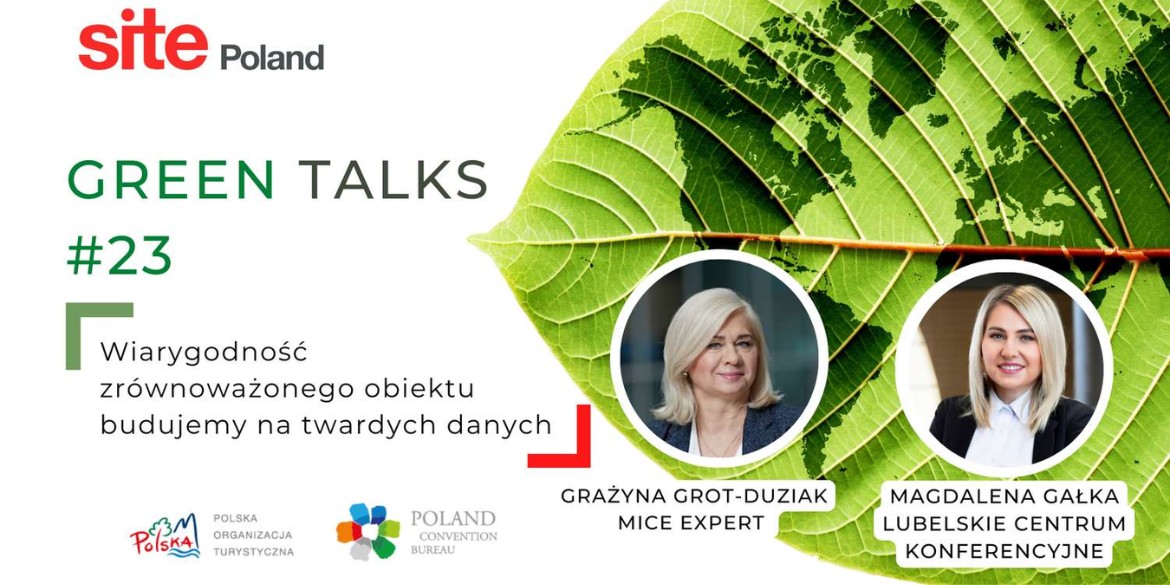
In this Green Talks edition, Magdalena Gałka of the Lublin Conference Centre (LCK) shares with Grazyna Grot-Dudziak (SITE Poland) how a consistent ESG approach – built on environmental responsibility, community engagement, and strong governance – translates into real operational outcomes. From advanced technologies to in-house team management, LCK demonstrates how sustainable practices can enhance both event quality and business performance in the meetings industry.
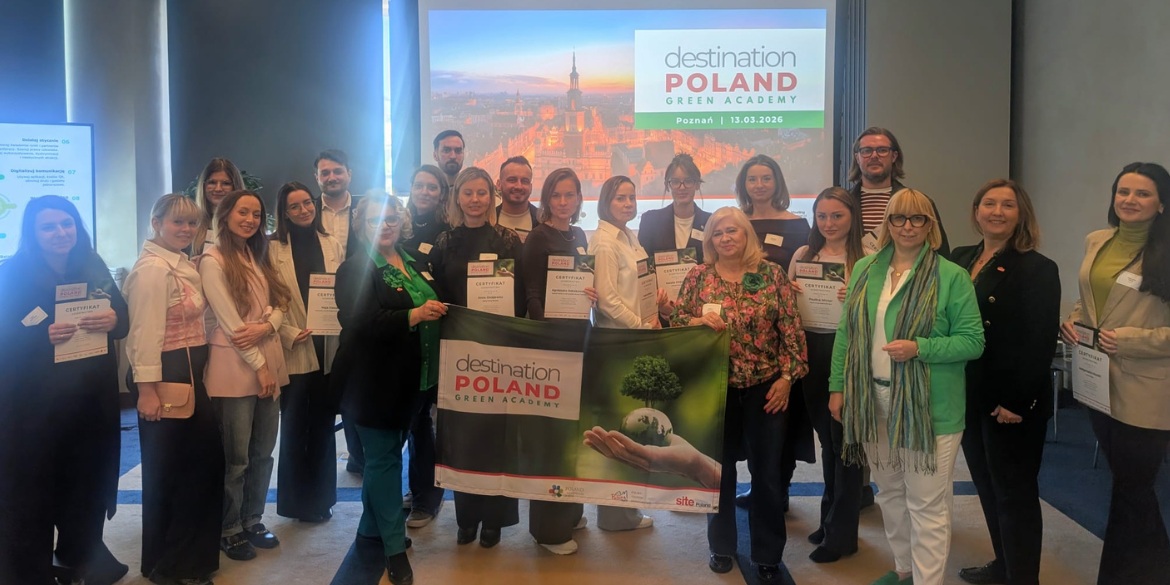
Grażyna Grot-Duziak: During the Destination Poland Green Academy workshops in Lublin, you presented the sustainable practices implemented at LCK. We were highly impressed by the consistency and scope of your initiatives. Sustainability is increasingly becoming a key element in the strategies of conference centres. What role does it play in the operations of the Lublin Conference Centre, and what pillars underpin your ESG approach?
Magdalena Gałka: At LCK, sustainability is not just an industry buzzword or an add-on to our strategy. Since the very beginning of our operations in 2016, we have based it on three pillars: environment, community and governance. Our compass is the Code of Ethics, which we implemented at the launch of our activity. We do not look for excuses – we continuously improve our management processes. For us, this is the only path to building a modern venue that genuinely serves the region.
LCK is a technologically advanced facility. What solutions have you implemented in the building to reduce energy and resource consumption and minimise the carbon footprint of events?
Our venue uses intelligent technologies that genuinely reduce its carbon footprint. Among the many solutions implemented, one example is the ground heat exchanger, which stabilises the temperature within the cavity of our glass façade.
Instead of consuming costly energy every day to heat this vast space in winter or cool it in summer, we draw on the free resources of the ground. We also operate an advanced BMS system, solar collectors and a rainwater recovery system, enabling us to manage resources more efficiently while ensuring guest comfort economically and responsibly. And this is only one element of our broader commitment to the community.
Large congresses involve complex logistics and significant resource consumption. In practice, how do you manage energy, water and waste at LCK during large-scale events?
At LCK in Lublin, resource management is based on a simple principle: the less we waste, the better we plan. Our in-house team plays a key role here. Moving away from outsourcing towards directly employed staff is not only a cost-saving measure, but also a way of genuinely strengthening one of our three pillars – community. This approach gives us direct control over water and energy consumption, as well as reliable waste segregation, which would not be possible with anonymous external contractors. Together with our partners, we promote the concept of “green events”, demonstrating that smart economics and care for people go hand in hand.
What certifications and standards confirm the environmental and ethical quality of LCK’s operations, and why are they important for event organisers?
Facts confirm our quality: every fourth event at LCK is a medical conference, which requires uncompromising ethics and the highest standards. We build credibility on hard data – we hold the ICEB certificate from Kraków, which serves as a “certificate of purity” for the building. We have achieved Class A for TSP (total suspended particles), which are responsible for smog, meaning we have almost completely eliminated their emissions, protecting the health of our guests and local residents. We have also achieved Class B for benzo(a)pyrene, reducing emissions of this carcinogenic substance by nearly 73.2%. These parameters confirm that our emissions in key categories are close to zero.
Are conference and congress organisers increasingly asking about environmental and sustainability aspects? How does LCK respond to these market expectations?
Clients are looking for partners who genuinely care about the planet, and we provide them with tangible evidence in the form of measurable reductions in energy consumption. LCK combines advanced technologies with a focus on human wellbeing, which is reflected, for example, in our lighting solutions. We have chosen lighting with parameters safe for the eyes (photobiological risk group zero), ensuring that even long congress sessions do not cause eye strain.
As a result, organisers can strengthen their brand as leaders in responsible business, while our venue becomes a natural choice that combines prestige with real sustainability and participant comfort.
LCK hosts many international events. What “green” solutions do you offer organisers of meetings such as Connect Aviation to reduce their environmental impact?
For organisers of international events such as Connect Aviation, we act as a partner providing ready-made “green” solutions. We offer full digitalisation, eliminating the need for printed materials, as well as intelligent lighting controlled by motion sensors, helping to minimise the carbon footprint of large-scale business events.
Our greatest advantage – as I often emphasise – is our in-house team. By moving away from outsourcing, we are able to personally oversee every detail, from reliable waste segregation to optimising catering in line with zero-waste principles. We create a barrier-free environment that is fully accessible and compliant with global standards. At LCK, we demonstrate that prestige is closely tied to genuine sustainability and genuine care for people.
Sustainability is not only about the environment, but also about the community. How does LCK collaborate with the local community and support the development of the Lubelskie region?
At LCK, sustainability is realised through strong local engagement. We are not just a building, but a platform for developing social capital. We create our own projects, such as exhibitions and historical performances, which attract and integrate the local community, giving our activities a unique cultural dimension.
We support local creators and stimulate the Lubelskie economy by facilitating knowledge transfer between academia and global business. Each such event represents a tangible implementation of the “S” (social) pillar in our ESG strategy – we are building a strong brand as a leader in the meetings industry, combining innovation with respect for regional identity.
One of the more distinctive elements of your strategy is the move away from outsourcing towards an in-house team. How has this decision affected operations, employee engagement and operating costs?
Our absolute standout achievement – as I have highlighted many times – is the transition from outsourcing to a fully integrated in-house team. We employed security and cleaning staff on stable employment contracts, which has resulted in exceptional engagement. The effect? Service costs dropped dramatically in the very first year, from over PLN 770,000 to just PLN 371,000 annually. This is our real “profit” from an ethical approach – financial savings combined with increased employee loyalty. It proves that respect for people simply leads to better financial performance.
What are LCK’s next steps towards further reducing environmental impact and developing sustainable events in the coming years?
Our strategy is based on “smart, incremental steps”. Rather than revolution, each year we focus on specific energy-efficient investments that genuinely reduce the building’s carbon footprint. We are consistently modernising our infrastructure to manage water and energy consumption even more precisely. A key element of these plans is the continued development of our in-house team’s competencies, as our employees are at the heart of these changes. We intend to further reduce waste and attract global events that want to take place in the “green” environment of LCK. We are not slowing down, because reducing environmental impact benefits us all.
Thank you very much for this insightful conversation, and we wish you many successful events in your modern venue.
Thank you for the interview!
Grażyna Grot-Duziak, SITE Poland, Expert of the Destination Poland Green Academy workshops.
Interviewee: Magdalena Gałka

Destination Poland Green Academy
Destination Poland Green Academy is a nationwide educational programme delivered by the SITE Poland in cooperation with the Polish Tourism Organisation – Poland Convention Bureau. The project aims to strengthen the MICE industry’s competencies in ESG and the delivery of sustainable events