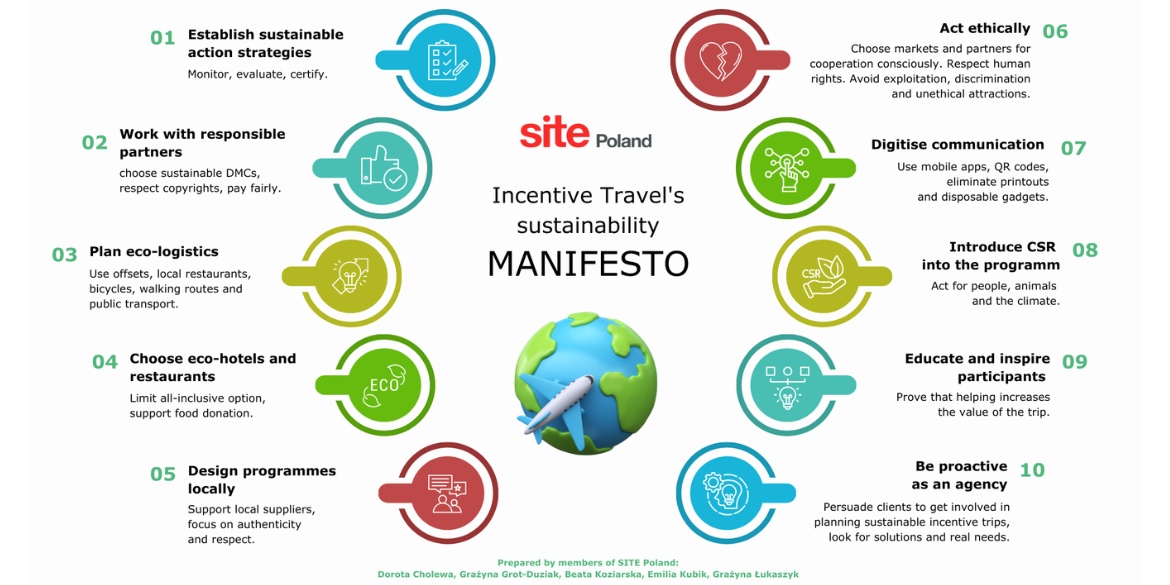
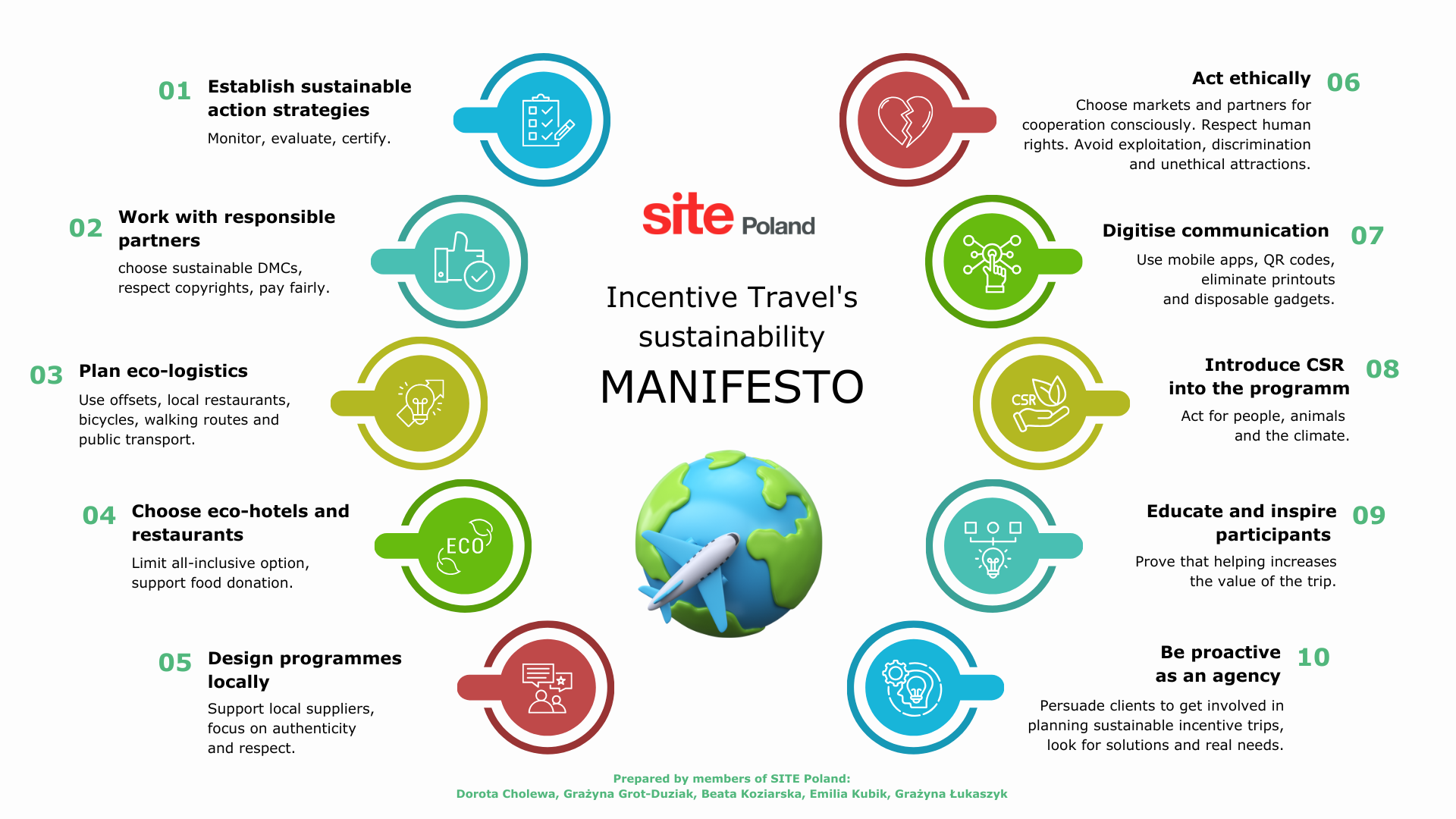
The Sustainable Incentive Travel Manifesto is a clear statement of Polish event professionals’ commitment to ethical practice and to aligning the incentive travel sector with SITE’s values and globally recognised standards for responsible tourism. Through this Manifesto, SITE Poland aims to mobilise every stakeholder across the incentive travel ecosystem, encouraging each to take ownership and define their role in designing programmes that are sustainable by intent, not by accident.
The decisions made every day by agencies, hotels, destinations, carriers and service partners carry tangible ethical, social and reputational impacts. Influence sits across the supply chain, and so does accountability. This is a shared responsibility.
SITE Poland believes the proposals and recommendations set out in this document offer practical direction and useful support for all organisations and individuals who want to deliver incentive travel in a way that safeguards the well-being of people and the planet.
Manifesto Ten Pilars
- Establish a sustainability strategy
- Work with responsible partners
- Plan eco-logistics
- Select eco-conscious hotels and restaurants
- Build programs locally
- Act ethically
- Digitise your communications
- Integrate CSR into the program
- Educate and inspire participants
- Lead proactively as an agency
Download PDF The Sustainable Incentive Travel Manifesto by SITE Poland
01. Establish a sustainability strategy
In today’s business environment, incentive agencies and destinations should operate responsibly, uphold the highest ethical and professional standards, create positive impact, and shape their environment sustainably.
This becomes achievable with a clear sustainability strategy and an action plan that integrates the agency’s—and all market stakeholders’—business goals with care for people and the planet.
Pillars of a sustainability strategy
- Ethical relationships with employees and partners – ensure decent working conditions, uphold human rights, provide fair pay, and set realistic commercial terms.
- Responsible tourism – design programs aligned with ESG principles and respectful of local culture and the environment; educate participants and encourage joint CSR initiatives that support local projects and nonprofits.
Discover more: Destination Poland Green Academy: all hands on deck for a sustainable future for the MICE industry!
Recommendations
- Commit deliberately. Decide to embark on your company’s sustainability journey and involve employees, clients, partners, and suppliers in delivering it. (Clearly define the strategy and communicate it to your team and business partners. Engage employees in developing the action plan. Set realistic goals aligned with your time, resources, and capabilities.)
- Develop ESG and CSR expertise. Attend relevant local and international conferences and training as a team. Track global best practices and adopt those that fit your context. Keep a shared record of what you learn and the commitments you make.
- Pursue certification. Treat certification as the next milestone after strategy. The process can be long and costly, but it enables progress tracking, stimulates innovation, and supports meaningful results analysis.
Benefits of implementing a sustainability strategy
- Reputation and competitiveness. Clients increasingly prefer companies that demonstrate – and can document – care for the environment and society.
Employee motivation. People are more engaged when their work contributes to a positive impact. - Implementing a sustainability strategy takes commitment and consistency. Organisations that operate with clear frameworks and written policies achieve the best results. A “small steps” approach accelerates adoption—early wins build momentum and make it easier to take on bigger challenges.
02. Work with responsible partners
A sustainability strategy applies not only to an agency’s internal operations, but also to its suppliers and partners. Running projects this way ensures consistency and delivers greater benefits for everyone. Here are SITE Poland’s recommendations
Verify – work with the best
Ensure suppliers and business partners share your principles and values.
- Communicate your sustainability policy, expectations, and requirements.
- Use a supplier evaluation form – verify credibility and capacity: check registration details, financials, certificates, and attestations. Request evidence of alignment with your strategy – especially in the ethical treatment of employees, respect for human rights, the thoughtful selection of attractions and subcontractors, and the protection of the natural environment.
- Communicate clearly, set requirements, and act when behaviour is inconsistent with sustainability standards.
Hold yourself to the same standards
- Respect copyrights, know-how, and the time and expertise of suppliers and competitors.
- Don’t discredit competitors; provide accurate information during negotiations.
- Treat proposals as original works; don’t share them without the author’s consent.
- Don’t issue RFPs merely to harvest ideas for your own execution.
- Provide feedback after receiving an offer; if you decline, explain why.
- Pay on time, compensate fairly, and don’t profit excessively at a supplier’s expense.
Adopt an internal code of conduct to guide relationships with business partners and within your organisation. It should set clear standards for:
- fair competition,
- anti-corruption,
- conflict-of-interest management,
- information and data protection,
- non-discrimination,
- protection of the company’s know-how.
Better Together: GDS-Forum and Impact Day 2026 in Szczecin, Poland
03. Plan eco-logistics
Ecological travel means choosing transport modes and timings consciously – and, where possible, skipping transfers altogether. It also includes financial contributions that help carriers pursue innovative, lower-impact solutions.
Whenever you can, prioritise rail (the lowest-impact option), use public transport and bicycles, and choose restaurants within walking distance of the hotel.
Air travel
Flights and transfers typically account for the largest share of a trip’s emissions. Reduce impact by choosing nonstop routes and airlines that invest in pro-environmental measures. In incentive travel, flying is often unavoidable – but what can’t be avoided can be balanced.
Carbon offsets
Offset programs let you compensate for emissions by funding renewable energy, reforestation, biodiversity protection, or social projects. Offsets are straightforward to include in the trip budget and signal accountability for the journey’s full environmental footprint.
Recommendations
- Review and offer offsets. Check the chosen airline’s carbon-offset program, include the options in your proposal, explain the benefits, and—where possible—co-fund the offsets.
- Look beyond offsets. During delivery, verify the carrier’s other measures (e.g., SAF usage, eliminating single-use plastics, lightweight recycled serviceware, optimised routes and flight times).
- Communicate early. Inform the client and participants—ideally via the event app—before departure to set a sustainability mindset from the start.
- Pack lighter. Encourage participants to reduce luggage by at least 1 kg each; estimate the group-wide savings and share the result.
Program logistics
Designing eco-logistics takes more time, research, and operational flexibility—but it pays off by ensuring the trip is planned end-to-end in line with sustainability principles.
Recommendations
- Plan locally from the start. When drafting the offer, factor in local logistics and consult the local convention bureau or tourism organisation for guidance.
- Leverage ready-made solutions. Many destinations offer group discounts or complimentary public-transport passes—use them.
- Minimise transfers. Sequence program elements along the same route and, where possible, on the same day.
- Keep meals walkable. Choose restaurants within about 1 km of the hotel so the group can walk to and from meals—and explore the neighbourhood.
- Promote low-impact sightseeing: favour walking tours and public transport for city visits.
- Add a cycling option. When suitable, plan short hops by bike or e-bike—most cities have bike-share programs.
04. Select eco-conscious hotels and restaurants
Sustainable tourism begins with deliberate choices. Selecting hotels and restaurants is more than logistics—it’s an opportunity to put ESG values into practice. Partnering with responsible venues delivers tangible benefits for the environment, strengthens local communities, and helps raise industry standards.
Recommendations
- Verify environmental and social standards. Choose venues with credible sustainability certifications (e.g., Green Key, LEED, Travelife, Biosphere) that cut plastic and energy use, invest in renewables, and manage water responsibly. Make these criteria part of your selection process and client communications.
- Request ESG documentation. Ask for the venue’s sustainability policy, ESG report, or environmental statement. Even simple frameworks show real action—and that your agency supports partners who take responsibility seriously.
- Limit all-inclusive and food waste. Avoid models that encourage overproduction or isolate guests from local culture. Include neighbourhood restaurants and support small businesses. Use “family-style to share” menus to build connection, reduce waste, and showcase authentic flavours.
- Right-size buffets and catering. Negotiate menus tailored to group size, profile, activity level, and daily meal count. Aim for variety over volume, and favour service that allows seconds rather than lavish spreads.
- Support food-redistribution. Work with venues that donate surplus food to charities or local communities. If no program exists, share knowledge and recommend partners (NGOs, community fridges).
- Favour local supply chains. Prioritise venues sourcing from local farmers, producers, and artisans—delivering freshness, a smaller footprint, and real economic support. Promote “farm-to-table” as a value, not a trend.
- Encourage seasonal, plant-forward menus. Discuss reducing animal products and leaning into seasonal ingredients; educate through taste. Every shift toward plant-based food lowers environmental impact.
- Eliminate single-use plastics. Choose venues with reusable tableware, natural packaging, water filters, waste sorting, and plastic-free catering. Small decisions compound.
- Check waste-management practices. Ask what happens to leftovers—composting, donation, reuse—and highlight good practices in participant communications.
- Add educational elements. Include cooking workshops with local chefs, meetings with producers, or market visits to raise awareness and deepen place-based learning.
Communicate and inspire. Explain your choices- why there’s no all-inclusive, why local suppliers matter, and how the venue was selected. Every event is an opportunity to educate and motivate.
05. Build programs locally
Every incentive trip is more than a reward or an adventure—it has real economic, social, and cultural impacts. Partnering with local businesses to co-design programs supports community growth and helps set higher standards for responsible tourism.
Recommendations
- Choose local partners. Work with businesses rooted in the community—family firms, local DMCs, artisans, and artists. They understand the cultural context and deliver authentic, respectful experiences.
- Engage local talent and creators. Hire passionate guides, chefs, artists, and cultural animators. Build programs on the place’s real story—not staged attractions.
- Centre local voices. Give space to local experts, activists, and community leaders. Participants become guests, not just tourists.
- Invest in long-term partnerships. Go back, recommend, and co-create future projects—lasting ties build stability, growth, and local ownership.
- Strengthen local supply chains. Prioritise regional suppliers for catering, gifts, and décor—boosting micro-enterprises, showcasing craft, and lowering the footprint.
- Avoid turning culture into spectacle. Respect symbols, traditions, and narratives; design experiences with meaning, context, and dignity.
- Respect the social context. Partner with organisations that respect residents and the environment. Design programs that integrate with local life rather than disrupt it. Treat CSR as standard practice, not an add-on.
- Tell the local story. Share who prepared the dinner, who designed the workshop, and where the products come from. Transparency adds depth and quality.
- Prepare participants. Provide pre-trip guidance on customs, basic language, cultural norms, and sensitive topics to prevent misunderstandings and build mutual understanding.
Discover more: Green Talks – A Boatman’s Passion on the Vistula River
06. Act ethically
Ethics come first. If a destination or attraction raises concerns, opt out. Do not work with partners or in markets that violate international law, abuse human rights, or are subject to official sanctions (e.g., UN, EU, ICC).
Recommendations: exclude or avoid attractions that…
Violate human rights or social norms
- Respect international law, local regulations, and universal values.
- Maintain zero tolerance for forced labour, child labour, and human trafficking.
- Do not organise activities where abuse occurs (e.g., tours that expose poverty as entertainment).
Exploit poverty
- Do not treat poverty as a program element—avoid so-called “poverty tourism” or visits to poor districts as attractions.
- If your program includes a charitable or CSR component, ensure support reaches communities in a dignified, needs-based way, in partnership with local organisations.
- Highlight positive examples of entrepreneurship and local development instead of spotlighting hardship.
Harm the natural environment
- Avoid activities without required permits in protected areas.
- Do not drive off-road outside designated routes or leave litter.
- Do not damage ecosystems (e.g., touching reefs, collecting protected plants).
- Choose suppliers with environmental certifications; minimise your footprint and use carbon offsets.
Promote discrimination or intolerance
- Exclude anything that could be seen as racist, sexist, homophobic, xenophobic, or otherwise exclusionary, including practices that normalise unequal treatment of any community.
- Avoid jokes, games, or scenarios built on ethnic, gender, or religious stereotypes.
- Design inclusive programs where everyone feels respected.
Exploit animals in inhumane ways
- Ban shows with wild animals in poor conditions, animal rides, and “photo-ops” with captive wildlife.
- Allow animal encounters only as observation in the wild or visits to certified rehabilitation centres.
Engage in “dark tourism” without a proper context
- Do not visit sites of tragedy as entertainment.
- Avoid selfies and recordings at memorial sites that could be seen as disrespectful.
- Provide accurate historical and educational context and uphold the dignity of the place.
Good practices for organisers
- Verify suppliers against ESG and CSR standards.
- Educate participants about local culture, customs, and norms.
- Promote authentic, responsible, and inclusive experiences.
- Support local communities in meaningful, needs-based, long-term ways.
Destination Poland Green Academy: all hands on deck for a sustainable future for the MICE industry!
Remember
Choices of destinations, partners, and markets have real reputational, ethical, and social consequences.
As incentive travel organisers, we have both influence and responsibility.
This Manifesto affirms our commitment to industry ethics and to aligning our actions with SITE’s values and global standards for responsible tourism.
07. Digitise your communications
Digital tools significantly reduce environmental impact and enable clear, real-time communication with clients and participants alike.
Recommendations:
- Replace print with mobile apps. Use a dedicated event app for program details, locations, and schedules; enable real-time updates, targeted reminders, and ongoing communication.
- Educate participants. Explain the benefits of going digital and encourage use—highlight environmental gains and convenience.
- Educate participants. Explain the benefits of going digital and encourage adoption—highlight environmental gains and convenience.
- Plan. Give participants time to install the app and download materials. Ensure equal access; if print is requested, ask why and present effective digital alternatives.
- Use QR codes. Place them on badges and signage (e.g., entrance boards or booths) for session details, live polls, and digital giveaways.
- Avoid single-use swag. Instead of paper welcome packs, offer vouchers, e-books, or access to exclusive online content to reduce waste and transport.
- Communicate digitally. Send invitations, registration links, reminders, and thank-you notes via email and push notifications—no printed mailing or attendee lists.
- Build in interactivity. Enable in-app Q&A, voting, and feedback to cut printing and boost engagement.
- Enable access and support. Make sure all participants can use the tools; assist as needed.
Understand needs.
Plan so participants have time to install the app and download materials. Ensure equal access to communication tools and offer support to anyone who needs it. If a client requests printed materials, ask why, highlight the benefits of going digital, and present effective alternatives.
08. Integrate CSR into the program
Modern incentive planning demands long-term, responsible thinking. Social responsibility isn’t about image; it’s a strategic choice and a core part of the program—one that leaves a lasting, positive impact on participants and destinations.
In incentives, CSR goes beyond an ESG checkbox—it’s a firm position, practised consistently, with local partners and in line with your values.
Recommendations
- Start with purpose, not obligation. CSR should stem from genuine need, not a desire to meet market expectations. Choose activities that fit the trip’s theme, your company’s values, and the real needs of the local community. One well-planned action is worth more than several symbolic gestures.
- Communicate the purpose and engage participants. CSR shouldn’t be an afterthought—explain the partnerships, goals, and value. Evoke emotion, educate, and invite co-creation.
- Keep it simple and authentic. Big budgets aren’t required. Use engaging formats that deliver value—tree planting, cooking with local communities, supporting schools, and beach clean-ups. Time-box CSR to about 5% of the program so it adds value without breaking the trip’s rhythm.
- Work locally, in partnership. Co-create with local organisations, foundations, and community leaders. Provide logistical, financial, and program support.
- Link actions to global goals. Reference the Sustainable Development Goals (SDGs) or your ESG strategy to add significance and coherence.
- Respect nature and animal welfare. Exclude activities based on animal exploitation; replace them with educational experiences, visits to certified rehabilitation centres, and meetings with environmental NGOs.
- Eliminate harmful or unethical activities. Avoid anything that violates community rights, trivialises cultures, harms people or animals, or disrupts daily life.
- Build a narrative and continuity. Explain why you chose the initiative, who stands behind it, and what it achieved. After the trip, report outcomes, thank partners, and suggest at-home follow-ups. Instead of another gadget, give participants a meaningful summary—an invitation to stay engaged.
09. Educate and inspire participants
Education and inspiration around sustainability increase awareness of the environmental, social, and economic dimensions of travel. Incentive trips are powerful rewards that motivate teams to perform, collaborate, and aim higher. Show participants how the journey can be enriched with purposeful experiences
Doing good together and choosing responsibly strengthen relationships, foster empathy and inclusion, and spur collective action—making the experience more mindful for everyone.
How to do it
Be a trendsetter: inspire, inform, encourage.
- As the organiser, speak openly about the need for thoughtful planning. Highlight the advantages you stand behind and flag drawbacks when you disagree with client expectations—transparency and honesty matter.
- Start small, prove the value, and build from there. The best results come when both sides share the same level of understanding and commitment.
- Even standard elements—like meals—can help: choose venues run by local foundations or charities, where profits support their mission.
Above all: communicate
- Share clear information about the trip’s sustainability features.
- Send it early so participants can absorb it, prepare, and ask questions.
- Explain how the itinerary supports your sustainability goals.
- Use numbers and real examples—they resonate most.
Communication examples
- Flights. Thanks to Company X’s decision to purchase carbon offsets, we will contribute [x USD] to Amazon reforestation / [x USD] to food assistance for children in [location].
- Transfers. We’ve selected several restaurants near the hotel. We’ll walk to dinner—about 10 minutes. Walking means movement, health, and fewer emissions in the city.
- Water. At the departure airport, you’ll receive a reusable bottle. Bring it to every program stop; we’ll ensure access to drinking water. By skipping plastic water bottles on coach transfers, our group will save 200+ single-use bottles.
- Tipping. Bring small bills and tip local staff; even a few dollars can go a long way locally.
- Restaurants. We’ve chosen locally run restaurants with menus based on regional recipes and ingredients—supporting the local economy and delivering top quality.
- Buffets. Use a small plate, take only what you’ll eat, and go back for seconds—this reduces food waste. Our partner hotels run sustainability initiatives; we’ll share tips in the app (e.g., opting out of daily linen and towel changes).
- Program & nature. We’ll spend time in nature—on the beach, in the water, and in the jungle. Please use repellents and sunscreen made with natural ingredients; don’t litter; stay on marked paths; don’t disturb wildlife or pick plants. Follow local rules and environmental regulations—and leave natural “souvenirs” where they belong.
CSR
If your itinerary includes a CSR initiative, describe it clearly in the app: why it was chosen, who the beneficiaries are, the expected outcomes, how participants should prepare before departure, and the rules for participation.
Recommendations:
- Survey participants. Ask for feedback on the CSR activity and publish the results in the app; we expect most will rate it as very important and want more in the future.
- Report outcomes. After the trip, summarise all environmental and social actions—highlight benefits and positive participant feedback.
- Share the summary. Provide it to both the client and participants.
- Normalise varied engagement. Don’t be discouraged if participation levels differ—it builds over time.
- Say thank you. Always acknowledge those who were active; recognition encourages others.
Education and inspiration on sustainability should be engaging and tailored to the group, destination, local needs, the client’s ESG policy, and available capacity.
10. Lead proactively as an agency
Don’t wait for clients to request sustainability elements. Act proactively—share your experience and ideas, and introduce even small changes that make a real difference. Require partners to propose activities and practices aligned with sustainable tourism. Treat sustainability as a business advantage: celebrate your achievements, and highlight certifications, which are increasingly recognized as a core part of corporate responsibility.
Recommendations:
- Start ESG thinking at the brief stage. Propose sustainability solutions early—CSR activities, local sourcing, plastic reduction—to position your agency as responsible from the outset.
- Present concrete solutions, not just ideas. Consult local convention bureaus and tourism organisations for recommendations and ready-made options. Show practical measures: plant-forward catering, recycled badges and gifts, and local suppliers.
- Align offers with client values. Understand priorities and tailor solutions. If a client has CSR/ESG commitments, emphasise education, reporting, and community engagement.
- Work with certified local partners. Choose partners that practice sustainability (e.g., EarthCheck, Rainforest Alliance) and local DMCs that support authenticity and sustainable development. Confirm they can provide ESG reporting.
- Monitor and report outcomes. After the event, deliver a clear summary—via a service completion email or a full ESG report—covering results such as: paper saved (kg), waste collected, local products used, eco actions in transport/logistics/partner choices, support for local communities, selection of ethical activities.
- Initiate inspiring CSR elements. Propose creative activities (tree planting, beach clean-ups, volunteering) with meaningful follow-ups—for example, a marketplace of local products as a reward for CSR participants.
Source: SITE Poland