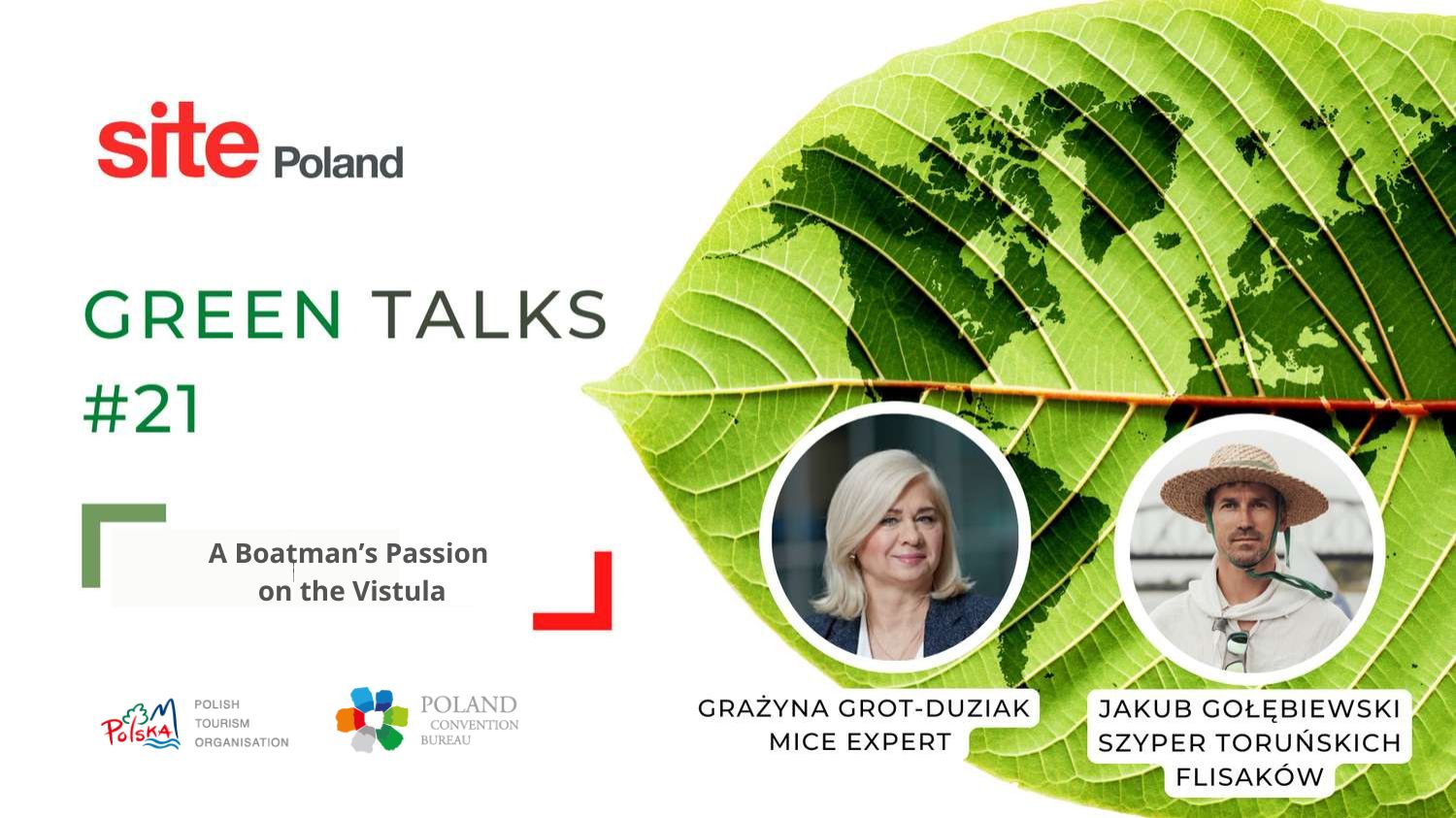
In Green Talks #21, part of the Destination Poland Green Academy series, Grażyna Grot-Duziak (SITE Poland) speaks with Jakub Gołębiewski, skipper of Toruńscy Flisacy and founder of the Wolna Wisła Foundation, about turning a personal passion for sailing and nature into a distinctive, low-impact tourism experience on the Vistula. From a wooden boat inspired by Toruń’s 700-year river heritage to storytelling that links local history with global threads, the conversation explores how authentic experiences can “sensitise” guests to nature, build a loyal community of returning travellers, and grow into a sustainable business grounded in place, culture, and responsibility.
Grażyna Grot-Duziak: During the workshops in the Destination Poland Green Academy series, you presented local best practices in sustainable tourism. The topic really engaged participants, so it is worth sharing more widely. How did it all begin? Where did the idea come from?
Jakub Gołębiewski: A few factors pushed me towards becoming a “flisak” (river boatman): sailing, the need to be in nature, and the necessity of finding stable work in Toruń. Around the time I was finishing my studies, I worked as a ski instructor in winter and a sailing instructor in summer. It wasn’t exactly a goldmine, but the work was fascinating and it allowed me to travel a lot. At the same time, I wanted to find something for myself in Toruń, a place where I could pursue my passion without getting bored.
One day, I had a flash of insight: for over 700 years, Toruń had been a shipping city. If people used to sail on the Vistula using simple technologies, then today, with modern materials, it should be possible too. That is how the idea for a company offering cruises on the Vistula was born.
At first, I planned a fibreglass motorboat with a VIP-cruise vibe, but my wife persuaded me to go in the direction of historical river navigation and buy a wooden boat. And that is how it all started in 2014.
The interview continues with Grażyna`s questions and Jakub`s answers.
Who are your customers? What do they appreciate most?
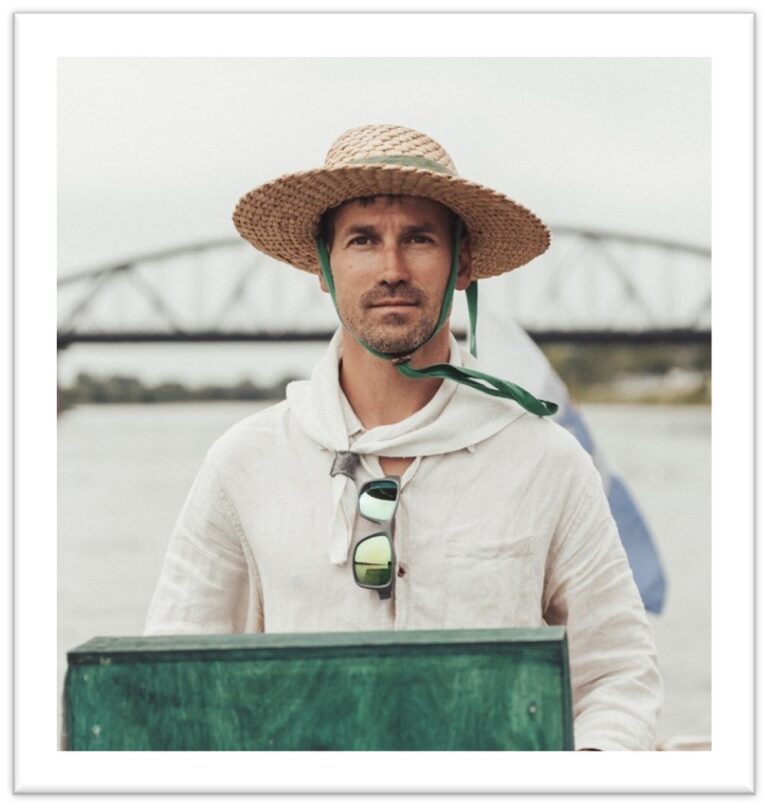
We have all sorts of customers. Most people are drawn to our cruises spontaneously: they’re walking along the boulevard and suddenly come across our boat. We try to make that kind of experience complete: a link to history through a reconstructed traditional boat, closeness to the water within arm’s reach, authenticity, the skippers in linen shirts and boatmen’s hats, and a direct experience of the river. We often talk about the history of Toruń and the local nature, we demonstrate the current, we check the depth with an oar, and we let people hear the silence when we switch off the engine.
Do you get visitors from abroad? Where from? How do they find you, and what are they interested in?
Yes, we do get visitors from abroad, usually individuals and families rather than groups. Spaniards, Czechs, Americans, Germans, and others. Some are simply passers-by, but most book tickets in advance via our website.
What are they interested in? I’m not entirely sure, because they rarely start with questions themselves. Most often, I begin the story. My favourite opening goes: “The history of Toruń begins in Palestine…”. Of course, I mean where the Teutonic Knights came from. It surprises most listeners, and then I have their attention. From there, I go on, but I always try to connect to threads that may be familiar to my guests, depending on where they come from. I almost always find some connection, because Toruń was plugged into global networks from the very beginning.
We also have customers who crave longer trips, camping, and conversations by the campfire. That’s my closest “tribe”. We make sure that every year, they can experience a few journeys like that.
Does that mean you have your own “club”, a circle of customers you spend longer with than just a few hours on a Vistula cruise?
Yes, we have our “fans” who return for different cruises. There are also those who specifically hunt for expedition-style trips. Sometimes we organise them especially, and sometimes they happen as one-way opportunities. For example, a municipality or a city commissions us to run traditional boatmen’s animations or cruises for residents, and then we announce that people can join us to, say, Włocławek. That’s when the “adventure hunters” often appear.
Does the fact that it’s an eco-minded product help you achieve the company’s goals?
For most customers, ecology isn’t the decisive factor, but it’s a field where a conscious entrepreneur can do a lot. We try to weave elements of ecological awareness and sustainable development into our services, even if the customer doesn’t ask for it. I prefer to talk about “sensitising people to nature” rather than “ecological education”.
The foundation is a positive experience in nature, a feeling that nature is our home. Once we feel that, we begin to protect it.
Would you say your business is a success now? Did it take a long time to get there?
After 11 completed boating seasons, only now do I feel a bit of stability. The first years were hard. “Madmen” was a pretty accurate label. The business ran on dreams, without a business plan. We tried everything: a youth boatmen’s club, cooking boatmen’s soup, building boats, a riverside garden, staging Teutonic “raids” on our own boats… Those were beautiful, romantic times, but not profitable from a business perspective.
The breakthrough came in 2024, when the City of Toruń was looking for an operator for five new boats in the heart of the boulevard. Today, the company operates like a normal business, and after two more seasons, I’ll be able to call it a real success.
Do you feel supported by local authorities and other institutions in developing an eco product?
Since we became the operator of the city’s boats, there’s been a lot of goodwill from the city. However, appreciation for our contribution to ecological awareness or promoting outdoor activity is smaller; what’s mainly valued is the city’s image and tourism. Institutions are more reactive than proactive. That’s why entrepreneurs who are serious about sustainability often have to act as leaders themselves.
That’s one of the reasons I left the City Council and founded the Wolna Wisła (Free Vistula) Foundation. I decided I could achieve more that way.
What would you advise others who have, seemingly, unusual ideas?
I wouldn’t want to advise anyone directly, because every situation is different. I can only say what I would do differently. First of all, it’s worth having an operational plan. I didn’t have one, so I wasted energy pursuing one vision after another, instead of focusing on what was realistically possible.
A sustainable approach means organising activities based on available resources and real needs, not endless desires. Now I’m trying not only to run a sustainable tourism business, but to be sustainable internally too. That’s the key to true success.
That’s very well put. We could add the “small steps” method, so you see results sooner and keep motivation. And that leads to a question about plans. Will you be introducing anything new, expanding your offer, reaching new customers, or perhaps strengthening cooperation with local authorities?
We have no shortage of plans. If anything, we have to limit them to keep our goals realistic. Many of those plans are still at the stage of “we want” and “we dream”:
- We want to bring back regular, cyclical gatherings in our riverside Community Garden, Wolna Wisła.
- We want to set up a small souvenir shop on Bulwar Filadelfijski. We want it to offer unique boatmen-themed souvenirs, as well as nature-inspired items that make the Vistula species better known.
- I dream of a large aquarium on the boulevards with Vistula fish, so everyone can see what the underwater ecosystem looks like, and how beautiful it could be if the water were clear again.
- I’m determined to hoist a sail on at least one of our boats this year. I want to teach my crew wind sailing and give passengers the chance to travel without an engine. First, it’s zero-emission, and second, the experience of sailing in silence among the sounds of the Vistula is a completely different world.
- We want to work with the authorities. We have many ideas for developing sustainable tourism and improving environmental quality. We travel a lot to partner organisations abroad, and we know where to draw inspiration from, but we also have our own strategy. We won’t go around begging, and we won’t organise demonstrations for a worthy cause. My experience is that authorities don’t really take grassroots activism into account. We want to grow, to become such an important tourism operator in the city and region that local decision-makers come to us themselves and ask what can be improved for the Vistula.
Thank you very much for a fascinating conversation. I hope the stage of “we want, we dream, we plan” turns into “we’ve done it!”, with satisfaction, and also “we’ve infected many people with our ideas”. Knowing your energy and determination, I think it will happen. Plans and dreams will always be with you, because what is life worth without dreams…
Thank you for the conversation.
Grażyna Grot-Duziak, SITE Poland, expert for Destination Poland Green Academy workshops
Jakub Gołębiewski, skipper of Toruńscy Flisacy (Toruń Riverboatmen), founder and president of the Wolna Wisła Foundation, an organisation that, through the tourism service Toruńscy Flisacy, helps people develop a deeper sensitivity to the beauty of the Vistula’s nature and the richness of cultural heritage connected with the river.
Destination Poland Green Academy is a nationwide educational programme delivered by the SITE Poland in cooperation with the Polish Tourism Organisation – Poland Convention Bureau. The project aims to strengthen the MICE industry’s competencies in ESG and the delivery of sustainable events