For the modern American event planner, the “Old Europe” circuit has begun to feel somewhat static. While the traditional hubs of the West offer a comfortable familiarity, they often lack the kinetic energy required for summits that aim to define the future. In its place, a new challenge has emerged: the search for a destination that combines high-tech sophistication with a “security-first” reliability and a profound intellectual gravity. The global meetings industry is currently witnessing a shift in its center of gravity. Organizations are no longer looking for a mere backdrop; they are looking for a Strategic Corridor.
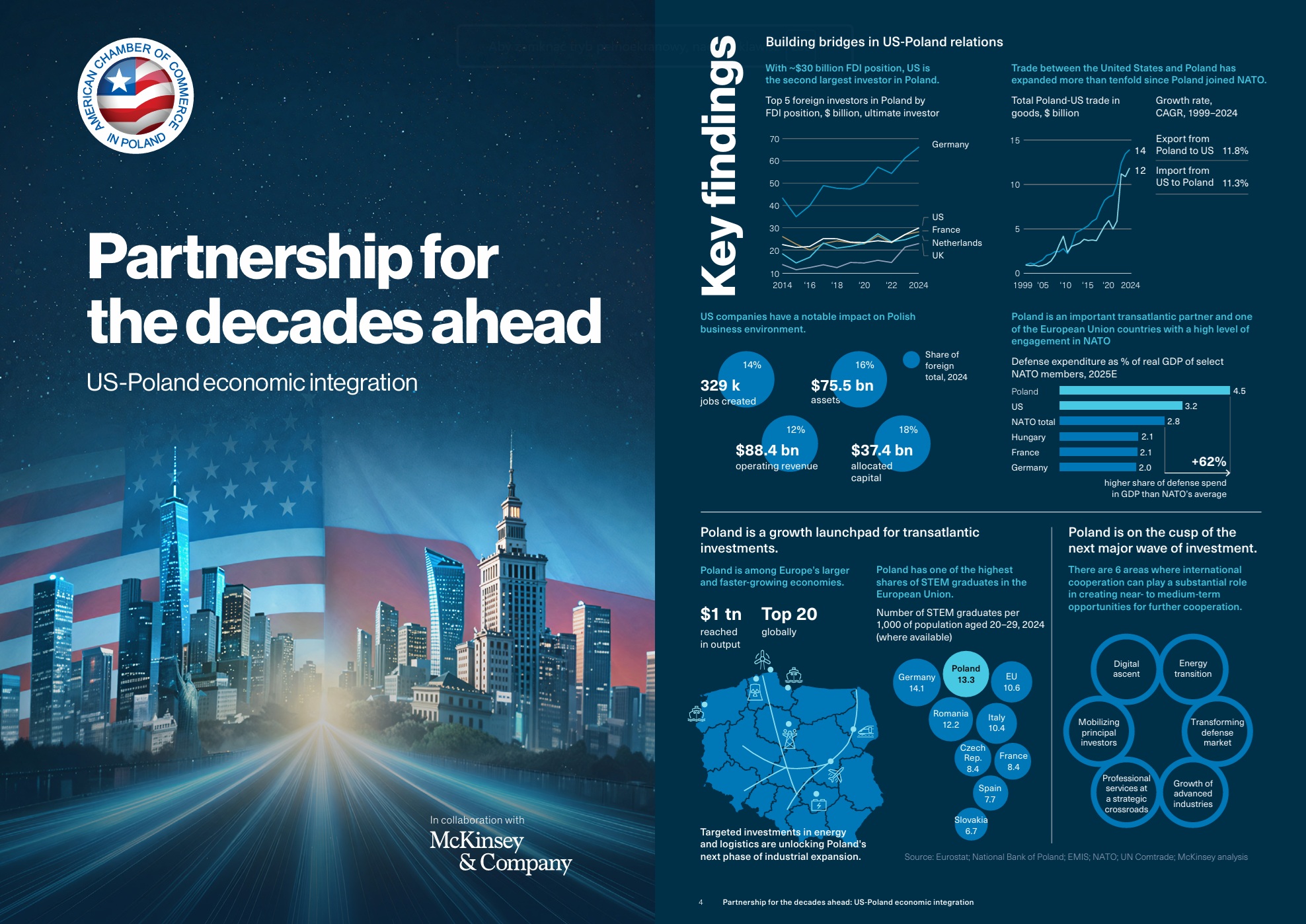
A landmark report by the American Chamber of Commerce (AmCham) and McKinsey & Company – Partnership for the Decades Ahead – reveals that Poland has evolved from a “cost-competitive location” into a “Growth Launchpad.” Today, the country stands as the linchpin of deterrence on NATO’s eastern flank and an integrated operating platform for the next decade of transatlantic partnership.
The Partnership for the decades ahead, US-Poland economic integration report can be downloaded here.
1. From “Emerging” to “Powerhouse”: The $1 Trillion Milestone
Poland is no longer an “emerging market”; it is a top 20 global economy. In 2025, the country will reach a historic milestone as its economic output surpasses $1 trillion.
For an event planner, this macroeconomic weight translates into world-class infrastructure and service standards that don’t just meet expectations – they set them. Poland is a unique outlier in the European Union, having maintained uninterrupted growth since 1990.
Perhaps most impressive is the momentum: trade between the United States and Poland has expanded more than tenfold since Poland joined NATO in 1999. This isn’t just stability; it is an economic velocity that ensures your event’s supply chain is robust, predictable, and resilient.
Poland has moved from being an aid recipient to a key participant in the global economic order. This journey toward the G20 symbolizes a destination with the highest developmental aspirations, perfectly suited for corporate summits that aim to inspire.
2. The “Talent Gravity” of 70,000 STEM Graduates
The success of a technical conference or medical congress depends on the local “brain trust.” Poland has become a magnet for knowledge-intensive sectors, producing between 65,000 and 70,000 STEM graduates every year. With 13.3 STEM graduates per 1,000 inhabitants aged 20–29, Poland significantly outpaces the EU average (10.6) and even Germany.
This isn’t just a statistic; it’s the energy that powers global icons. This is the ecosystem that produced the founders and core engineers of OpenAI, ElevenLabs, and Snowflake.
When you host an event in Warsaw or Kraków, your delegates are not just visiting a city; they are entering a high-velocity intellectual hub. Combined with a workforce that ranks in the top 20 worldwide for English proficiency, the result is a frictionless environment for high-level knowledge exchange.
3. The $30 Billion “Trust” Factor
American event planners are rarely the “first movers” in Poland; they are entering a matured ecosystem already home to 1,600 US firms. The United States is the largest non-EU investor in Poland, with an “ultimate investor” position of $30 billion.
This capital commitment acts as a guarantor of stability. When hosting a high-profile summit, you are supported by the same standards of corporate governance and professionalization found in New York or Silicon Valley. Notably, Professional Services is now the fastest-growing sector for US investment, nearly doubling (87% growth) in the last year alone.
Top Sectors for US Investment in Poland
Sector and Impact & Strategic Context
- Manufacturing – ~38% of FDI; A global hub for Aerospace (Boeing, Pratt & Whitney).
- Professional Services – Fastest-growing sector (87% YOY growth); the backbone of high-stakes corporate events.
- IT & Communication – 33% YOY growth; Base for Google, Intel, Amazon, and AI development.
- Defense & Security – NATO’s highest defense spend (4.5%+ GDP); a “security-first” reliability guarantee.
4. Regional Specialization: Backstage Access to the Corridor
One of Poland’s greatest MICE strengths is its geographic diversity. Beyond the skyscrapers of Warsaw, the country offers specialized industrial clusters that provide “study tour” opportunities and exclusive site visits for trade delegations.
- The Aviation Valley: Imagine a technical site visit where your delegates get backstage access to the titans of the Transatlantic Corridor. In the Subcarpathian region, aerospace giants like Boeing and Pratt & Whitney have built an ecosystem that is ideal for high-level engineering summits.
- Agri-Food & Supply Chain Transparency: Poland’s food security is underpinned by a massive production network. For industry conferences, the narrative of “supply chain transparency” is best told here – where a brand like McDonald’s integrates with over 120 local suppliers in a nationwide network of 618 restaurants.
- The Digital Triangle: Warsaw, Kraków, and Wrocław have evolved into integrated platforms for global tech, offering a sophisticated, high-energy backdrop for the world’s leading AI and software summits.
5. The “Home Field Advantage” for American Attendees
While Western Europe may feel increasingly ambivalent toward American influence, Poland offers a profound cultural and consumer affinity. According to Ipsos, 40% of Polish consumers are likely to choose US-produced goods – one of the highest rates of American brand affinity on the continent.
For the planner, this is the “Home Field Advantage.” American attendees don’t just feel welcomed; they feel understood. The partnership is rooted in a “shared understanding of freedom, trust, and common values.” From the hospitality standards to the common business lexicon, the transition for US-based delegations is seamless, rooted in a mutual respect that makes every attendee feel like they are operating on familiar, yet excitingly new, ground.
Conclusion: The Future of the Corridor
Poland has moved beyond being a cost-competitive alternative; it has become an essential, integrated operating platform for global innovation. In a world where security and innovation are the new currency of business events, the choice of destination has never been more strategic. With the highest level of US investment of any non-EU partner, your organization is joining a movement that is already 330,000 jobs deep and $30 billion strong.
In a world where security and innovation are the new currency of events, is your next conference anchored in a destination that’s simply standing still, or one that’s currently defining the future of the transatlantic corridor?
Partnership for the decades ahead US-Poland economic integration publication is available here.
Read also
- Nobu Hotel Warsaw has been awarded the Green Key certification
- Poland at IMEX America 2025 – Highlights from Las Vegas
- AmCham’s 4th of July Celebration at the Royal Castle Gardens in Warsaw
- Poland Strengthens Ties with MPI: From Chicago to Las Vegas